Port Townsend,WA, 17-JAN-2026 – I almost got what I wanted, and I can, if I want to use a phone app for anchor drag.
I have a number of things to talk about, the Predict Wind documentation and instructions along the way.
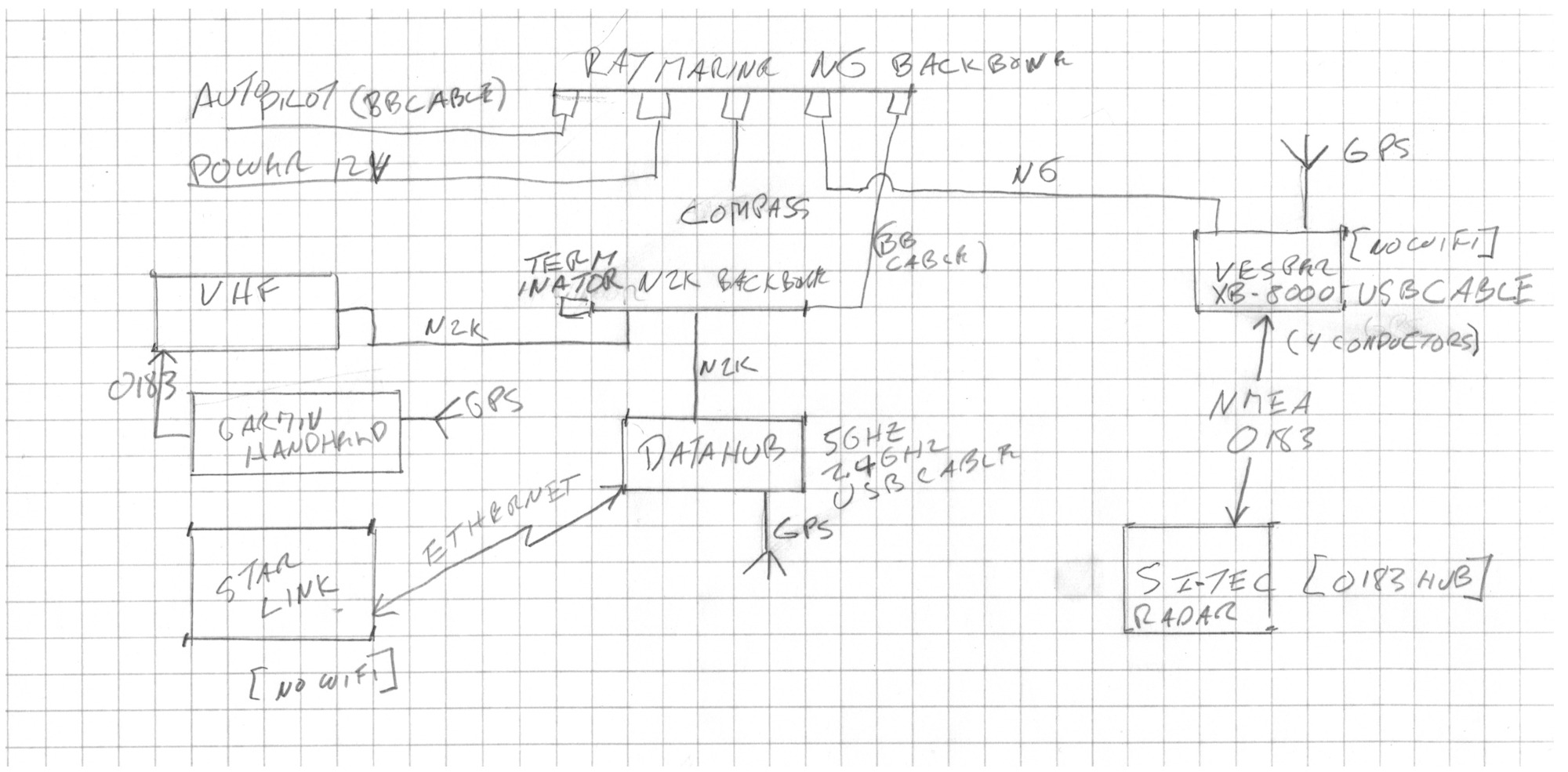
The lead-in diagram shows how the Raymarine NG is connected to the NMEA 2000 backbone. I’ll refer to NMEA 2000 as N2K.
One of the previous diagrams showed the backbones being connected through drop connectors. I don’t know whether that will work because Raymarine doesn’t make a cable to do that. Every device has a connector of one gender, the backbone drop port is the other gender. The N2K drop cables from Raymarine connector to the correct gender for the device, they can’t connect to a drop port. To connect the two back bones together, you need a backbone adapter cable that connects from the Raymarine Backbone to the N2K backbone. It works very well, by the way.
GPS on the DataHub is strange, if you follow PredictWind’s directions. They have you turn on the GPS in the DataHub, which seems to block other GPS senders on N2K. Leave it off and everything works fine. It took a while to figure that out.
AIS, GPS and Heading info are all relayed forward onto the N2K and Wifi… The DataHub takes care of Wifi. The heading info is the most interesting because, as I mentioned in the previous post, the Vesper doesn’t forward it.
I used the drop from the NG to the Vesper a little superstitiously. I need its GPS to get to the Raymarine Autopilot. It should work fine if I connected it directly to the N2K, but it has worked like this for years, so I kept it. I did connect it to the N2K and it worked fine there, but… I was just worried about it.
Our VHF also needs GPS data. I have always driven it with data from our Garmin handheld device over a 0183 RS422 serial cable. This made sure we had two working GPSes at all times, and I may return to that, but right now, the VHF is using the GPS available from the Vesper via N2K.
I tested getting to the internet using the hotspot on my phone, which now seems to be able to connect to a WiFi connection and be a hotspot at the same time. This may have made the DataHub redundant. The modern problem of no documentation with any device is here. In any case, the DataHub hooked right up to the hotspot, and my other devices connected to the internet through the Datahub.
I then turned off the hotspot and turned on Starlink. The DataHub immediately connected and worked very well.
OpenCPN on my laptop has been a little flaky. It won’t connect to the DataHub unless I toggle the connection setting. Then it works well. I even get the heading info from the Raymarine Auto Pilot.
There are two ways for OpenCPN to receive data from the DataHub. The first is the standard TCP/IP TCP connection, which works as well as always, there also is the GPSD connection, which I have never used before. GPSD is a protocol designed to share GPS data over tcp/ip. I don’t understand how that differs from the current protocol, but it works as well.
So far, everything is honkey-dory and all works according to plan.
Now onto things that don’t work as I hoped.
There are two Vesper AIS apps. The first, Watchmate, lists all of the AIS targets and gives the status of the device, including AIS status, and NMEA 2000. But I cannot find a way for it to connect to the Vesper. It does get a target list (or it did on one occasion) and listed distances, but it has not received our vessel’s GPS coordinates so it couldn’t place them on a ‘map’. There are no landmarks on the apps map (not a chart), but does give interesting info.
The big issue is that the anchor drag alarm can’t be reached as a result. The Vesper drag alarm is very good for two reasons: the first it runs on the Vesper, not a phone or handheld. and second it is connected to a loud alarm near the cockpit inside the companionway. It is turned off with a switch mounted there as well.
I can get to it by turning on the Vesper Wifi and connecting to it, but that gets rid of one the reasons for the DataHub.
At some point, I’ll turn off the StarLink Wifi and rename the DataHub LesPaul and hope for the best. I’ll keep Vesper turned on as an Access Point (“AP”) so I can connect the drag alarm. I’ll also shell out the $11.99US for the app necessary to use the DataHub alarm and hope my phone never goes dead during the night.
The second problem is the Vesper configuration app, vmAIS. It doesn’t work at all unless connected directly to the Vesper. See the solution above.
This vaguely reminiscent of my attempt to move to a single fuel for the boat, instead I ended up with four. Look for the blog post.
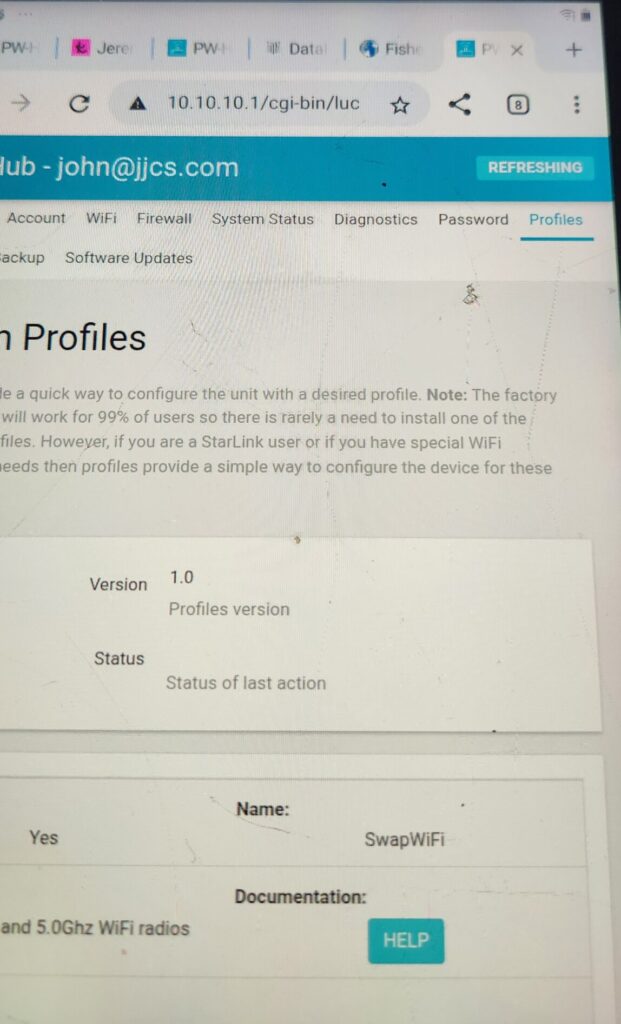
Last problem, is connecting my other devices to the DatHub. By default, the DataHub uses 2.4GHz as the connector to the internet and 5GHz as an access point. This backward from what I need and also a little crazy for other reasons. I need 2.4 GHz to be the radio for my devices to connect to, because a number of them only have a 2.4 GHz radio.
PredictWind has a solution for this. There is a ‘‘Profile,’’ which when installed reverses the ports. When I run it, the device I am connected with loses its connection (as the WiFi channel changes, I presume), but when I reconnect the radios are they were before I installed the change. I can connect to the DataHub using a USB connector, but I’m not sure my phone’s browser will talk over it.
The second day when I went to work on the DataHub early in the morning my house batteries were below ten volts. I started the engine and charged them. I already knew the answer to the next question because it had been sunny the entire day before: When checked with a hygrometer, every house battery was bad, not completely dead, but bad. The starting battery tested very good.
I must decide whether to replace the batteries with the flooded lead-acid batteries that I have now, or to go with Lithium Ferrous Oxide (LiPo4). LiPo4 will require a new charging system: a DC-to-DC charger off the alternator and possibly a new solar charger – I need to read the manual on my current charger and if it claims to work, decide how much I trust it. Victron are the gold standard in this arena, so I must make a decision.
I also must look into a 110V AC charger. I haven’t used one since Hawaii, but I should probably look into one. I need to get this settled and installed by mid-February.
I’ve been sick the last few days, but am better today. I’m repairing the switch in the vent over the stove and then tomorrow, I think I’ll start with the impeller and testing all of the bilge pumps, etc. I hope to go every day and get everything finished up by the end of the first week in February.
We’ll in Tucson for five days before then at the Gem show. I’m nervous about what Jennifer will want to bring back. It should be fun. We’ll see friends there as well.
I’m back to blogging, so there should be many more pieces.
We leave Port Hudson Marina, Port Townsend at the end of February for Olympia. We can leave the boat there across the summer for as long as we wish and this will allow Jennifer and me to go on road trips – all the way to Labrador. This is why I say we don’t actually live in PT. This is a great life.
