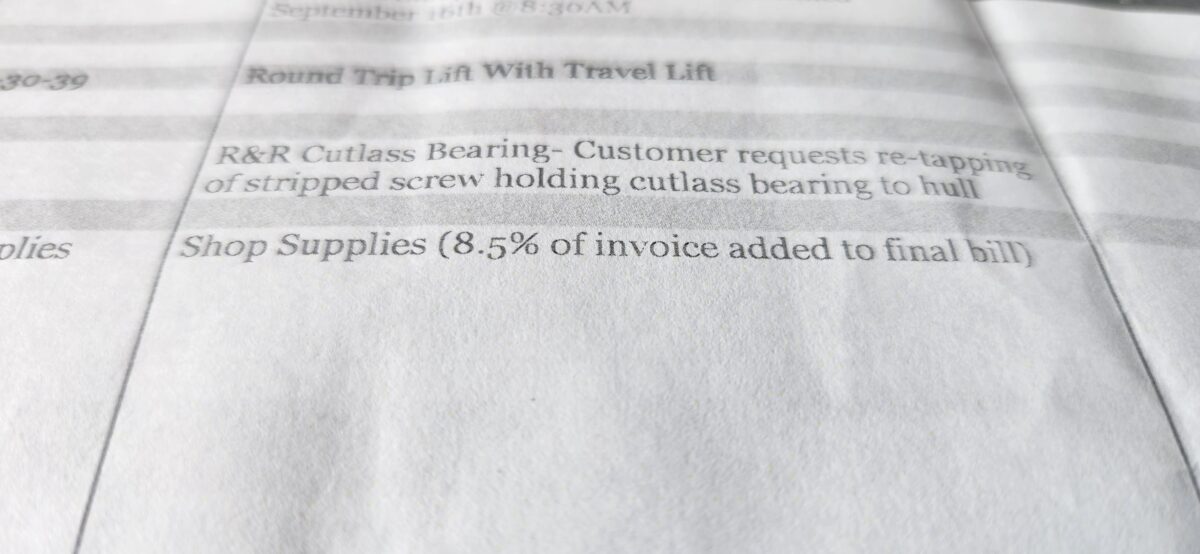
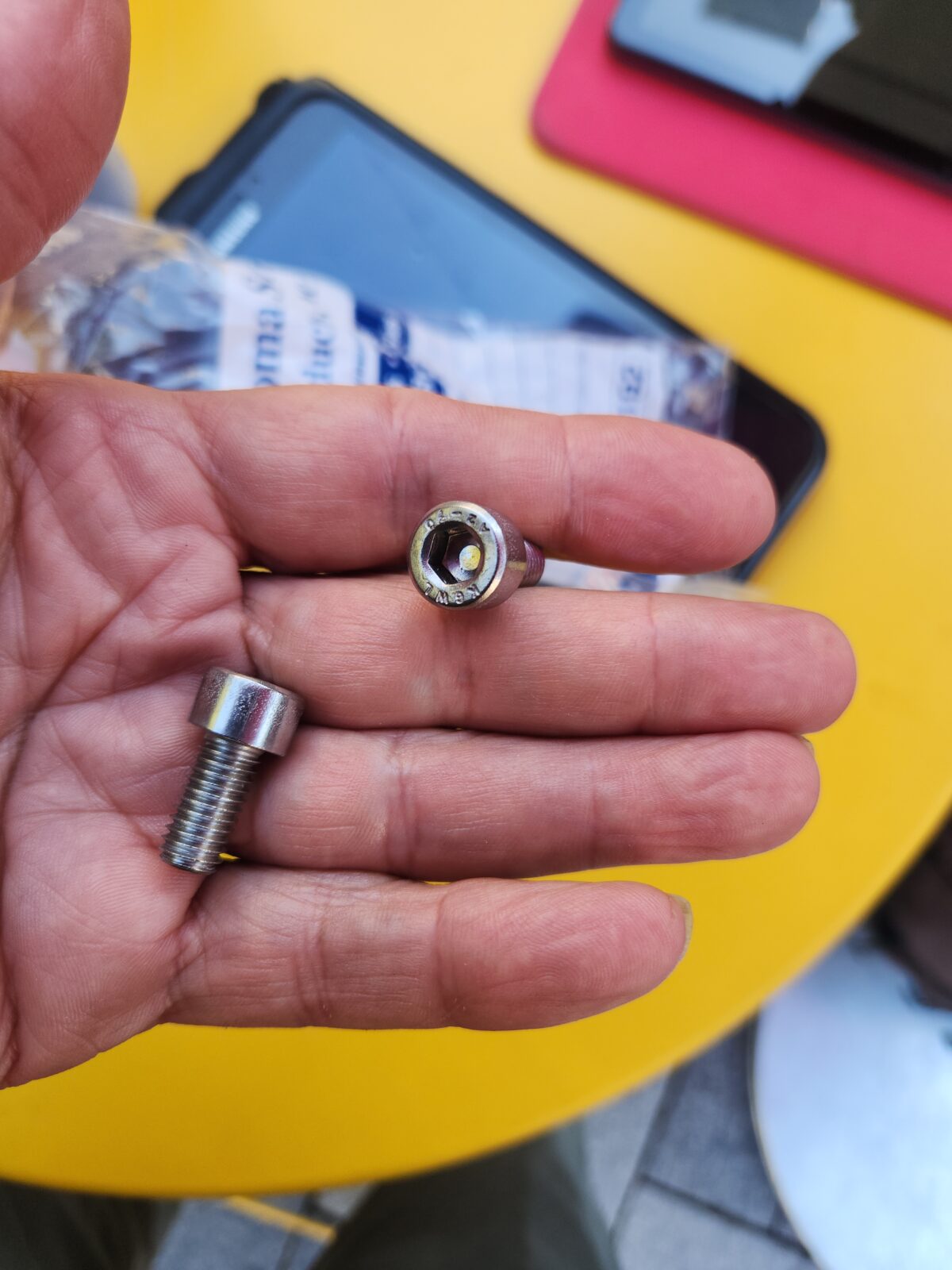
Blake Island Marina, 17-SEP-2026 – Another $1000 all together to get the cutlass bearing fixed. I could have done it in 90 minutes.
But I would have needed a machine shop for part of it. And I definitely would have needed a lift. That’s about $800. The extra two hundred isn’t too bad to swallow when you look at it that way.
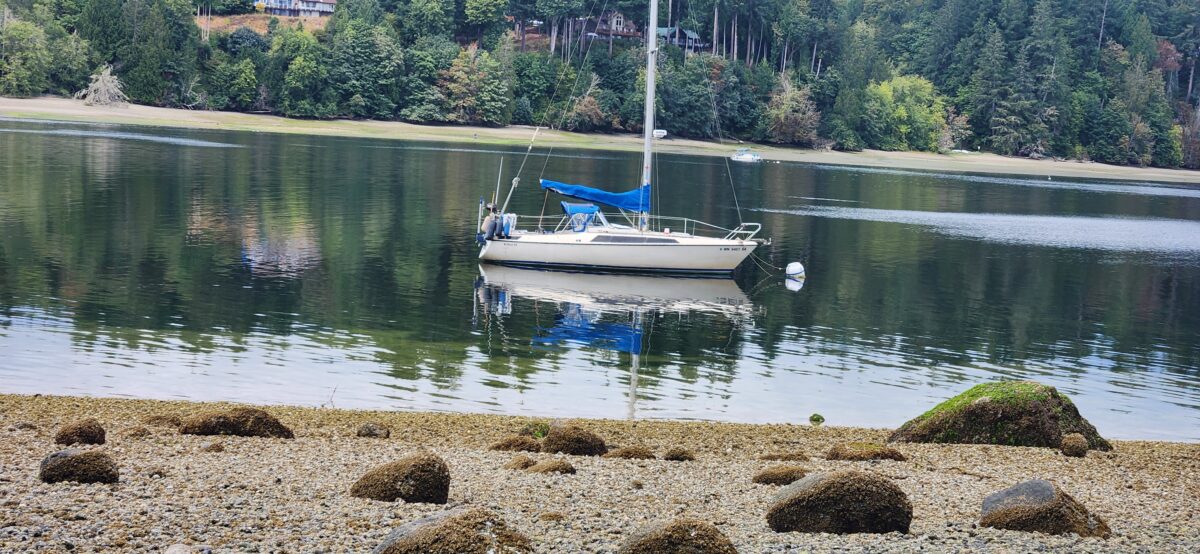
Dockton, Quartermaster Harbor, WA – 10-SEP-2026 – We arrived on the Sunday of Labor Day weekend – last weekend – to visit my friend John Riley. To see him again and work on his boat a bit. It was good to see him. He arranged a mooring ball for us. He came over for breakfast and dinner, I rowed over to his boat and he rowed over to ours. When we cast off the mooring ball on Tuesday, it sounded like someone had attached a coffee can full of bolts under the cockpit.
Eagle Island, Puget Sound, WA 6-SEP-2026 6:45 AM – ‘‘Get me the dog blanket, please,’’ says Jennifer as she settles into the cockpit to drink coffee, read the NYT and look at the seals.
This our fourth day at Eagle Island (after three nights). It is an island one can walk around in ten minutes at low tide and there are no eagles. Across the sound from us is part of greater Tacoma, north is a prison island, and south Anderson Island connected to Seattle by ferry. There are three mooring balls, one on this (east) side and two on the west. This time of year there are generally mooring balls available. The bottom here has very good holding so one can just drop an anchor if there isn’t a mooring ball available and then there is no limit on how long you can stay.
McMicken State Park, 30-AUG-2026 – I’ve been thinking about all the additions and changes I’ve made to Caro Babbo, and all the changes in my life that have happened during our ownership.
There are still things I learn about my boat. Not many and not startling. I’ve learned about solar panels and batteries this year. I’ve learned about Jabsco toilets – learned more about them really. Enough that I am rethinking the composting toilet I had planned for this year. And I am thinking about all the people that have come into my life and those that have left life during these thirteen years. Twenty-three years if I count when I moved aboard the T-bird that first summer.
McMicken Island State Park, 29-AUG-2026 – It’s Saturday, the last Saturday in August. We’re at anchor, on a mooring ball in Puget Sound. The people we run into don’t take there boats out of the country generally and the Sound is their boating world. Most are still working, so it is quite understandable.
We’ve been back from our Canada trip about a week and half and been on the boat since then. We’ve been out of Port Townsend for nine days. Three of those were in Swantown in Olympia.
Despite our travels, family and family responsibilities (and business) have crept into our travels. We were in Olympia to help Jennifer’s daughter change apartments. The new space is marvelous for her daughter and cat. It opens onto a public patio where there are people and those people bring their animals. I worked on the move one day, Jennifer worked on it part of two more, then her daughter had had enough of mom’s help and we left the next morning (yesterday).
46º18’N 60º7.5’W 25-JUN-2026 – I’m returning to eastern Canada. I haven’t been here in 53 years. I was 19.
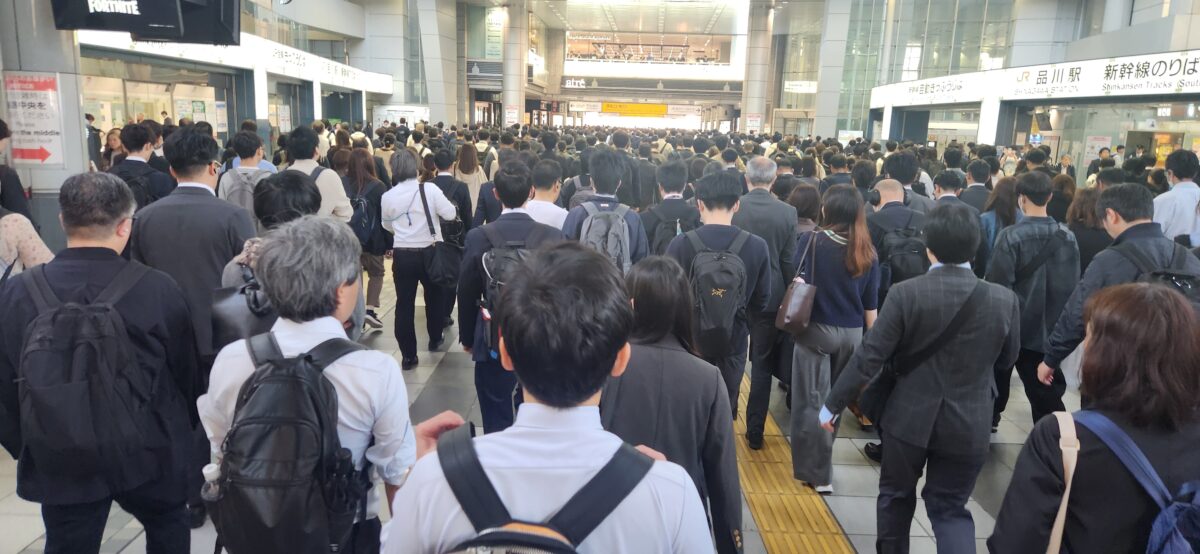
We left Port Townsend on the 5th of June, spent a night on the American side and crossed over. We’ve border crossed three times on this trip and never been asked a question beyond why are you/ why were you in Canada? The last time I crossed into eastern Canada was a different, though a very polite crossing with me allowing the customs guy to keep an allergy pill, over the belated protestations of my then girlfriend.
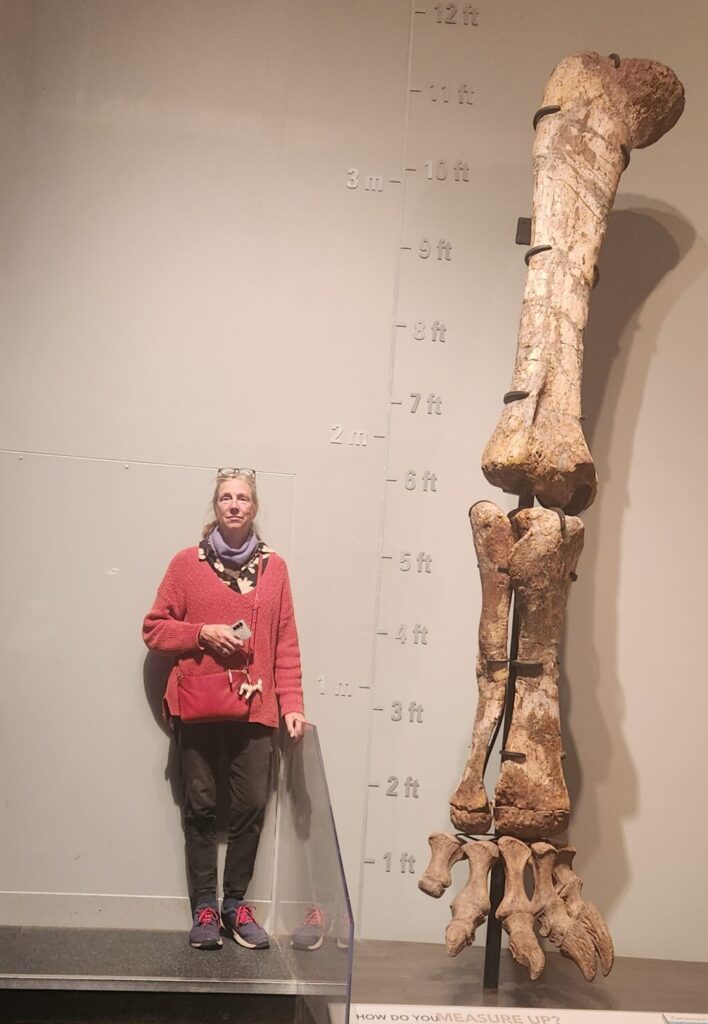
This trip has been a geology trip, Jennifer’s dream trip come true. We stopped a various geological sites: places where the layers of the planet were visible, a coal mine and a dinosaur graveyard in Alberta.
We spent the most time in Alberta of the provinces so far – that will change beginning tomorrow. (If you check the coordinates, you’ll know where we are going.) Drumheller and the area around there is where the Cretacious era dinosaurs fossils are exposed. The saying is that if you can go twenty feet without tripping over a fossil your not in Dinosuar Provincial Park. This isn’t hyperbole, but you must be on your hands and knees looking for fossils. Most are a few millimeters in size. The big dinosaurs are there, but either embedded in rock, or entombed.
This time, finally, the paleontolgical world has been specifying where the continents were at the time of whatever era they are talking about. For the times of the really big dinosaurs, Alberta was just above or below the equator. Nova Scotia was attached to Morocco. Things made sense for me finally. There were three die offs, mass extinctions, they’re referred to as. There were big dinosaurs, which weren’t called dinosaurs, that were all killed off, only to re-evolve ten or twenty million years later and be called dinosaurs.
[Interestingly, some researcher in Australia have predicted were in the middle of one, 40% of all species will disappear in the next couple of decades. Mostly insects, but as SCRAM meant in nuclear power development meant, the earth will do fine. In that college course, they talked about the amount of radiation necessary to result in mean dead earth. The guy teaching the course, then emphasized that this was air breathing creatures, creatures in the sea wouldn’t know anything had happened.]
The specific era in Alberta was four or five million years before T-Rex, but his smaller forbearer was present.
The number of these large beasts that existed was very large indeed, with herds of three thousand. But how many were there actually. No one, but no one would give a guess.
The land in Alberta is a plain with deep canyons cut out when fresh water carved up the land, leaving hoodoos standing. A hoodoo is a lump of harder earth which was not dissolved away by the rushing water, that still has the harder layer of stone supported by the column left behind. Yes, the plain that is Alberta where there were has a rock layer covering many layers of sand an other stuff below. As you know, as you descend, the layers were laid down over time. The lower the layer, the longer ago is was laid down.
These layers were quite flat. In Nova Scotia for example, the crashing of the continents where they bang together can made the layers tilt, go vertical, or fold on on top of the other, but here in Alberta they were in layers.
Which brings us back to how many dinosaurs were there. There areas dug out by the long ago water is a very small percentage of both the province and the land in the area. Is this exposed area representative of all of the are that wasn’t exposed? Is under the highways, under the developed and undeveloped land the same? Then the numbers are too high to calculate… but, were talking ten or twenty million years. That big a number is beyond comprehension. Elizabethan England was 600 years ago, the Egyptians were 4000 years ago. A million years is 250 times longer ago than the Egyptians, ten million is 2500 times. Ten million years, the number of years these large beasts roamed is 25,000 times the length of time since the Egyptians. So a billion of them, divided by ten million is just a thousand per year. There had to be many more than 100 billion of them. How many fossils are there starting with a population of 100 billion large animals?
Well, Canada and Alberta is very proud of these fossils. They have built the best museum I have ever seen, and the they label which are castings and which are actual fossils.
Jennifer and I spent eight hours in the museum. While we were there we started a conversation with one of the workers, Warren. Warren was quite knowledgeable and answered our questions. When I asked about how the place was funded, he spoke with enthusiasm and knowledge. He broke down the different entities that ran the place, who funded what, etc.
Warren mentioned that he started after high school when he rode his bike out and asked if he could volunteer. ‘‘I never left.’’
We spoke for about twenty minutes; I was feeling guilty about keeping him for so long so I broke off the conversation and said good bye.
After he did leave, I told Jennifer I should have asked him to walk around the museum with us.
The next day we went on a tour of the reserved lands at dinosaur park. The person taking us around (terrible weather, small group) was a young woman who has worked there three years and was discussing what she would do next – I thought I was monopolizing here and broke that off as well. We spoke later when she made it clear that we weren’t. I always encourage everyone to get a PhD. You have a much bigger effect when you run things rather than be an individual contributor – and you can get your own funding to decide what you’d like to work on.
A group of trucks went by while were we walking through the reserved lands. The woman mentioned the man driving one of the trucks. ‘‘He oversees the logistics of the site and ferries the researchers out. He’s an interesting guy. His name is Warren.’’ I mentioned we’d met someone named Warren. ‘‘He’s worked here his entire life,’’ the woman responded. I countered, ‘‘He didn’t go to college.’’ ‘‘Yes, he’s published papers, sponsored meetings, he runs lots of committees at the museum and internationally.’’
I should have asked him to walk with us.
Fossil hunting stopped for about 50-70 years in Alberta, and then started up again with people my age. It sounds like fishing in Alaska in the 70s, about the same time that fossil hunting got going. Very little oversight, great discoveries to be made, lots of fame to be gotten in fossils, and lots of wealth in fishing. Then came the regulations. Probably necessary in both, to both to prevent over fishing, and destruction of the fossil sites. You can’t keep any fossil you find in Alberta and most of the provinces and you need a license, which you must buy from someone who has one to commercial fish.
Who is Bertha Hart? I spoke with her in 1973 on the trip where the customs agent kept the allergy pill, which cost a dollar in 1973, about $11 in todays money. Keep reading.
47º 34N 169º 51N, 8-MAY-2026 – During the conversation with the senior staff that manages the hotel and restaurants, a discussion came up about the people who work for the hotel and restaurants. They are generally Filipino, then Malay and Indian. Though I was told that the people who interface with the guests are generally hired because they speak the language of the guests. So, while they were in Asia, they had a lot of Chinese speakers, and they will hire a lot of Mexicans for the Spanish speakers. He was somewhat unclear, or I didn’t understand the tenses of when these people were/would be hired.
Ovation of the Seas, 50º 57N 159º 22E, 7- May-2026 – We’re traveling at 20 knots in pretty calm water. It has been foggy. The ship has been blowing a fog horn: One long blast every two minutes.
There are 4100 guests and 1500 staff, close to 7000 people on board. Except at meals, it feels like less. At the start of meals, it is very crowded at lunch and breakfast. The other meals aren’t too bad. Most of the passengers have set times they eat at the same table with the same people, so there is some order.
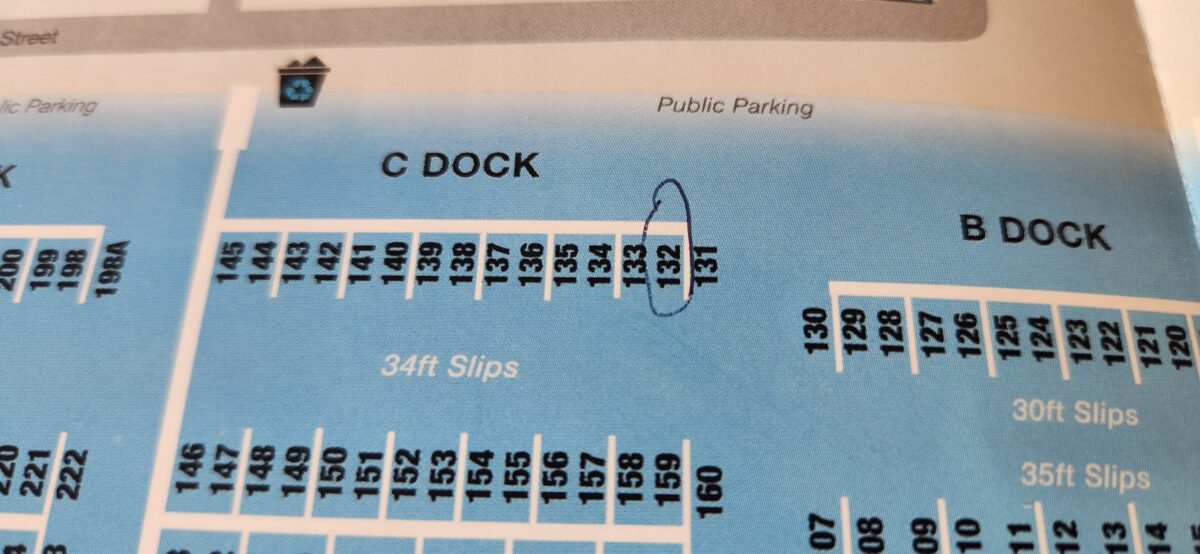
North East of Yokohama, 2-MAY-2026 – Let’s start with Caro Babbo: She’s in slip 132 in Boat Haven in Port Townsend. We can keep her there until October first, as long as we don’t leave the slip for more than three days. Then they will cancel our agreement and give the slip to someone else. No, they didn’t tell us that when they offered the slip. I found out when I went to the office to confirm things. I raised it with Kristian and told him we should each think about it, and I did. I expect we’ll keep it there until we want to go sailing, and then won’t bring it back until October when we return to Point Hudson and slip 28.