Point Hudson, 17-FEB-2026 – The last post should have been two parts. It ran on forever. I’m sorry. This is part two. We can mourn the fact that it is not part three. That would have made everything easier to read.
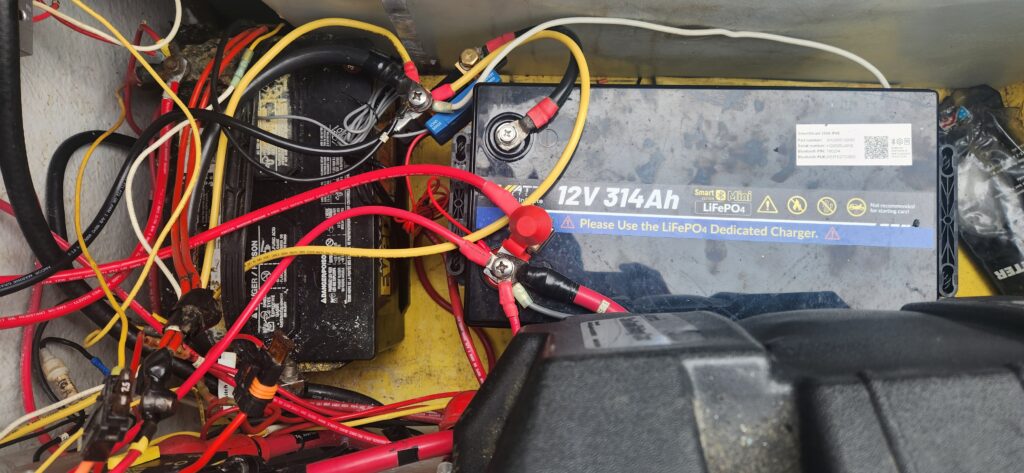
I finally finished the project by removing the wires from the shunt to a bus block. I also removed the mass of negative wires from the negative terminal to an existing bus block. Fusing is the reason why the positive was moved to a new block, and the negative was moved to an exisitng one.
The negative bus block is not fused. They never are, at least not when I wire them. Positive bus blocks generally are. Once the circuit is broken, it is broken: the current stops for the entire circuit.
By fusing with a circuit breaker between the battery and the bus block, if one thing draws all the power and trips the circuit breaker, everything is shut off. But I have things I do not want turned off unless they are individually failing. As I mentioned in part one, these are bilge pumps and VHF radio, among others. So these are on the positive bus block that does not have a circuit breaker – each item has its own fuse; if something goes bad that line will blow without effecting anything else.
I added a 60A terminal fuse, which shouldn’t be necessary. You can see it with the red cover over the battery terminal. The BMS limits the current going out to 200A, not enough to destroy the battery, but catch the wiring on fire.
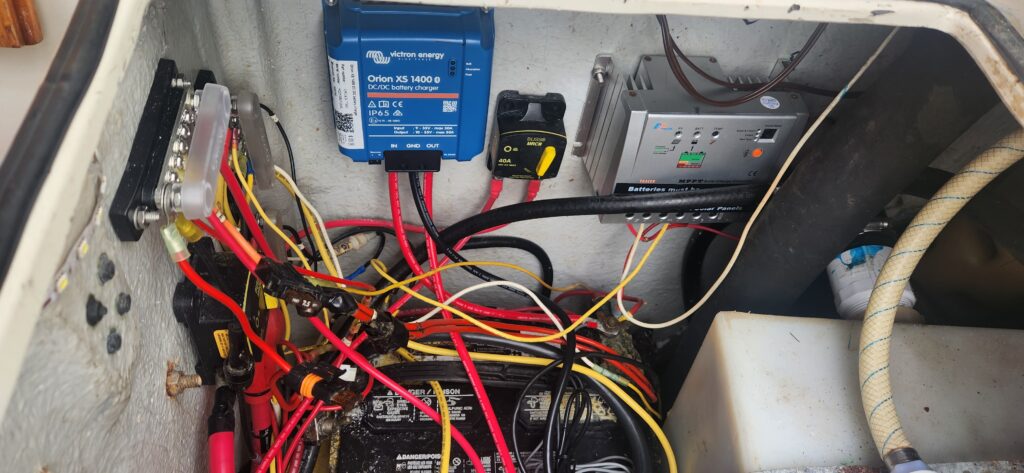
I also replaced the charge controller for the starter battery with the existing 10-year old Renogy MPPT charger that was in turn replaced by the Victron MPPT charger. The Victron can charge a lithium battery; the Renogy cannot. Using the Renogy MPPT charger on the starter battery made an immediate and noticeable difference.
The starter battery is charged from a small 20 watt panel on the front deck. It is a trickle charger, really, and wasn’t connected to any charge controller when I bought Caro Babbo. It was connected into a headliner light fixture. I learned this when I disconnected the house battery, where it was connected and still had power. It made sense to connect it to the starter battery. With the ACR it still contributed to the house battery and still will using the DC-DC charger.
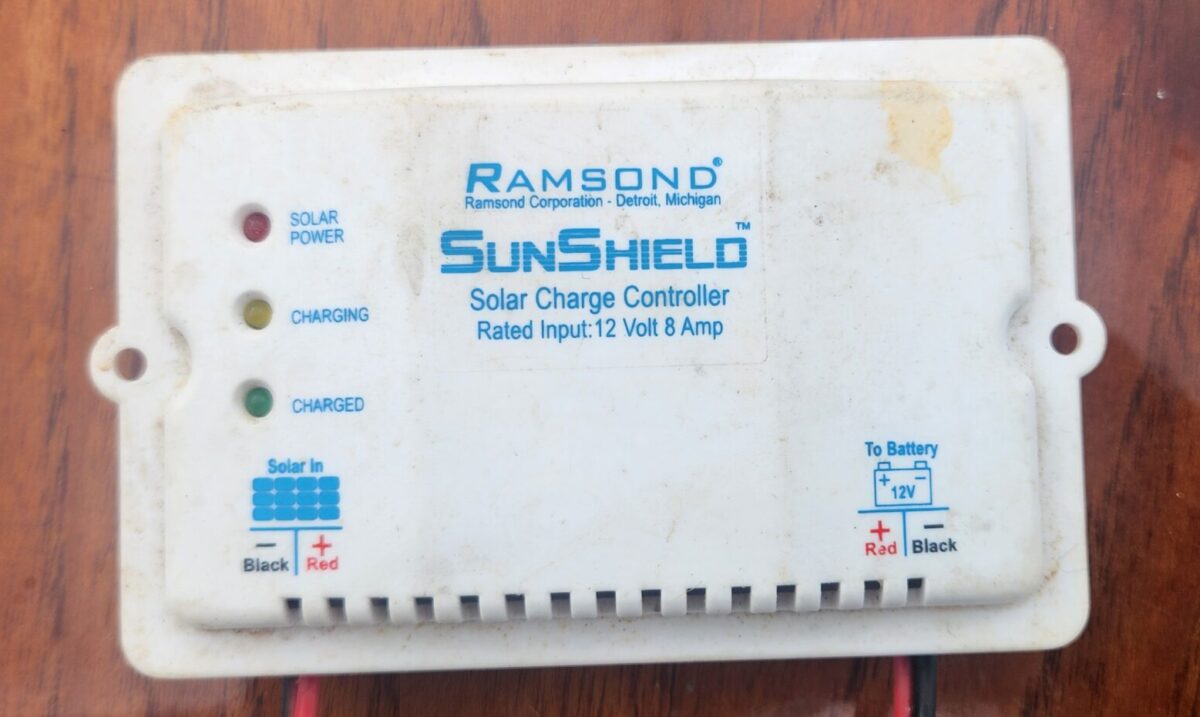
I’ll miss that little charger. The picture at the start of the post is that charger. I bought it in 2002 for the Thunderbird. I connected it to a 40 watt panel and a battery I got somewhere. 24 years is a very good run. It worked well all these years keeping Caro Babbo’s starter battery up to snuff.
This starter battery has lasted at least eight years. Pretty good for a flooded battery.
I still need to strap down the lithium and the flooded (starter) batteries and build a box to support the toolbox shelf. Then, maybe, we’re done with this project.
I also connected up the starter battery to the shunt so I can read its voltage. All these things I never knew about and did just fine, but I guess I could say the same about AIS, Radar, and lots of other things that keep us out of trouble.
While I was finishing up today, Lee and Kendra, from the boat in the next slip, came by with their same-age relatives. Kendra’s sister asked what I was working on. A project. She replied something about ‘‘a’’ project. I replied they are never ending. Kendra laughed and agreed.
I then asked Kendra if she got married yesterday. She said yes, they did. Just a small gathering at their home with her relatives and friends. I didn’t say I read about it in a Facebook post that Jennifer showed me. She was wearing a white dress with a veil and plunging into the water at Marine Center at Fort Worden with all the other weekly plungers. Too cold for me.
Lee and most of the group that came to the boat today had gone immediately into the cabin when they arrived. Kendra was trying to shuffle her sister into the boat as well. I turned my face down to continue my work, and they went inside.
It was cold, in the upper thirties. I wanted to clean up and come home for lunch. It is nice having the electrical done. The battery was at 90% charged when I left. Tomorrow, 100%? Probably Wednesday. It’s going to rain and snow later today and again tomorrow. There are still many projects to complete.
20-FEB-2026 – It is well below freezing this morning. I visited the boat to check what happens when the temperature is below 32ºF (0ºC). If the battery gets that cold, it will not take a charge and will shut down for powering things, I am told.
That’s why I bought a battery with a heater inside.
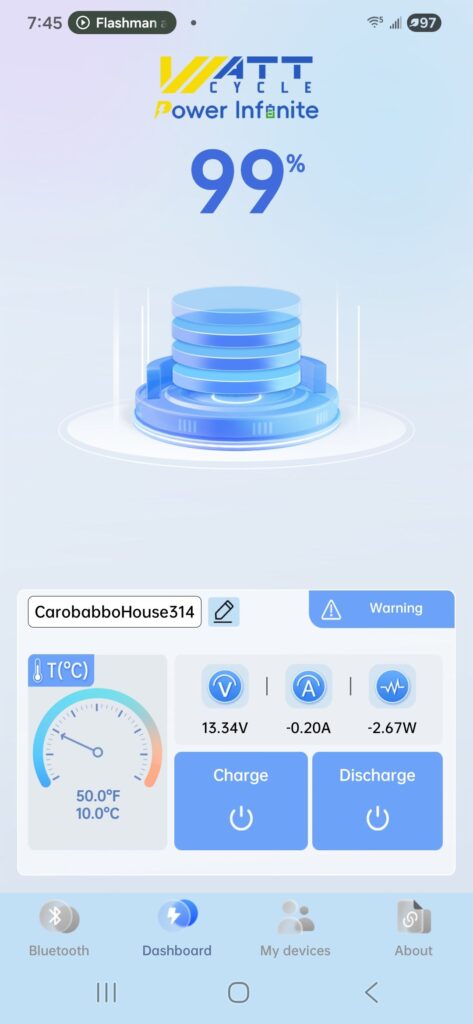
Sure enough, when I looked at the battery on the app, its temperature was 51ºF. It works. The battery was still taking a charge from the solar panels.