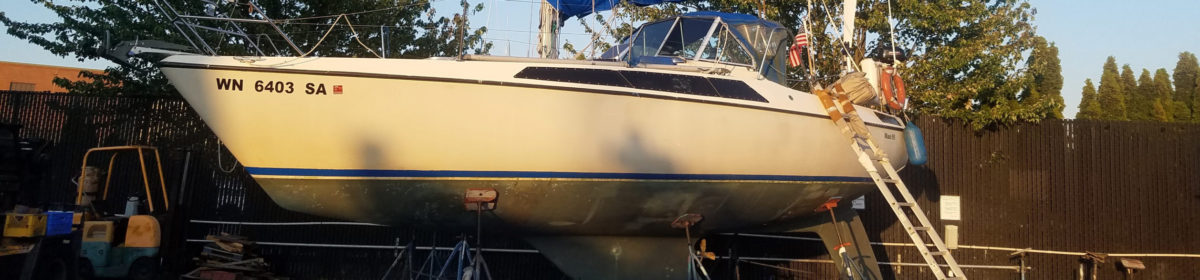
Port Townsend, WA, 13-JAN-2026 – As we add different electrical systems to Caro Babbo the number of WiFi networks we have climb. We find we have two sometimes three different WiFi networks running to access everything we want to use.
In 2013, we started out using the hot spot on our phone for what we wanted: access to grib files, normally. We connected up the Wifi (Catsaway), dragged down the Grib Files and did any surfing necessary on our tablets or laptops. We also looked at AIS targets using a product called Boatwatch, and eventually sent out our AIS target info the same way using Boatwatch’s sister product called BoatBeacon. [Prior to decent hot spot download limits we used a product called PDANet+ from June’s Fabrics and a wire tether to the phone.]
This worked fine, except when there was no phone service. We’d go a week or so with no outside connection to the world, using a VHF radio to listen to the coast guard reports. This had numerous downsides, including not having a way for people reach us when they needed to.
After a few years (2018), we bought an Iridium Go. Iridium is a satellite network launched in the 80s that allows earth stations to make phone calls and do some internet traffic. The sale of such things is/was(?) the wild, wild west, being all done through resellers, including phone and internet service. You needed to talk to multiple people and hunt for the best deal… until PredictWind got into the market with the lowest prices and the nicest people to deal with.
Unfortunately, with a monopoly on the technology, Iridium Go was launched in the 90s, there was never a need for the manufacturer to upgrade Iridium Go. Internet speeds were 1200 baud… dial up speeds from the early 80s, Grib files taking a hour to download, but it worked. Out of sight of land, it worked dependably, phones calls especially.
Les Paul was the SSID of the network we ran on the Iridium GO, 2.4 Ghz.
Why Les Paul? The Iridium bar is on the west side of Manhattan near Lincoln Center. In the basement is a jazz venue where Les Paul, the 1950s guitarist, played into his 90s. Hence, Les Paul.
We kept Les Paul on IridimGo for a number of years. It was what we used to sail to Hawaii. I used it to sail with Drew to San Francisco when his shortwave stopped working. It was a workhorse, but so slow, and it would only work as Access Point.
For a couple of years, we used it as a router between devices on the boat. We would have up to 11 of them and it worked quite well, even though the documentation said not to do that. Then a firmware update added additional satellites and I guess the processor wasn’t fast enough to keep up. Data would drop, connections would fail and all hell broke loose.

Before we left for Hawaii, I added AIS in the form of a Vesper-8000. For its time, a remarkable device that did a good job of AIS, could act as a router or connect to an access point, it also spoke on NMEA 2000 and NMEA 0183, translating everything back and forth. Garmin bought Vesper and in the next firmware update removed the heading, speed and other routing translation from the device. (I’ll explain why that is important, later.)
However, the Vesper wouldn’t act as router and connect to an access point at the same time. We needed both, so it became the router for all of the devices, normally, and any time we needed internet, we disconnected from vesper and connected to the IridiumGO, if there was no phone service.
IridiumGO is $140/month unlimited Internet and 90 minutes of phone service with no rollover, unlimited SMS text messaging both directions. Outgoing calls are free, incoming cost the caller $18/minute (The rates are when we last used it in 2023.) At 1200 baud, to download a 1GB movie would take one year at 24 hours per day, seven days per week.
Various devices, like the printer and scanner were set up to connect to Les Paul.
Further, after a Samsung firmware update, which has perpetuated forward, when the phone connects to a WiFi network, calling over the cellular network is turned off!
But we had a working method for communications wherever we went.
In 2024, we bought Starlink, which changed the world. We first used it in a small harbor on Kodiak Island in 2023. Jeanie Shepheard of Mush Bay, who had just installed it, ran it on solar panels. I asked if I could connect, which I did, and the world changed. The purchase price is about $800, about the same as Iridium Go, $140 for unlimited data usage (the same as IridiumGo) and ran at 300Mb per second. About 200,000 times faster than the IridiumGo.
In Hawaii, in 2020, we watched the trains of Starlink Satellites fly over on their way into orbit.
I ordered a Starlink in Homer in 2024 and installed it on our deck. We named the network Les Paul so everything would work the way it did when we used the Iridium Go. Working in the boat yard with reliable phone and internet was a revelation. Though there is always that small sorrow as things get easier and easier.
But now it was changing networks on a continual basis, depending on whether we wanted to learn where we were and what was around us, or internet.
Why didn’t we just connect the Vesper-8000 to Starlink, that would make everything work, correct? It would while Starlink is turned on, but Starlink uses 45 watts of power, something we can’t and won’t run for long without the engine running (a couple of hours). When we are using our phones for internet, we’re back where we started.
Other boats were having the same problem; they wanted to be able to connect to their onboard network from anywhere on the planet… and I guess allow anyone else to do so as well. (Predictwind, the hero of this story, says be careful who you give access to, because they can program your navigational equipment, especially if your equipment can execute a course!)
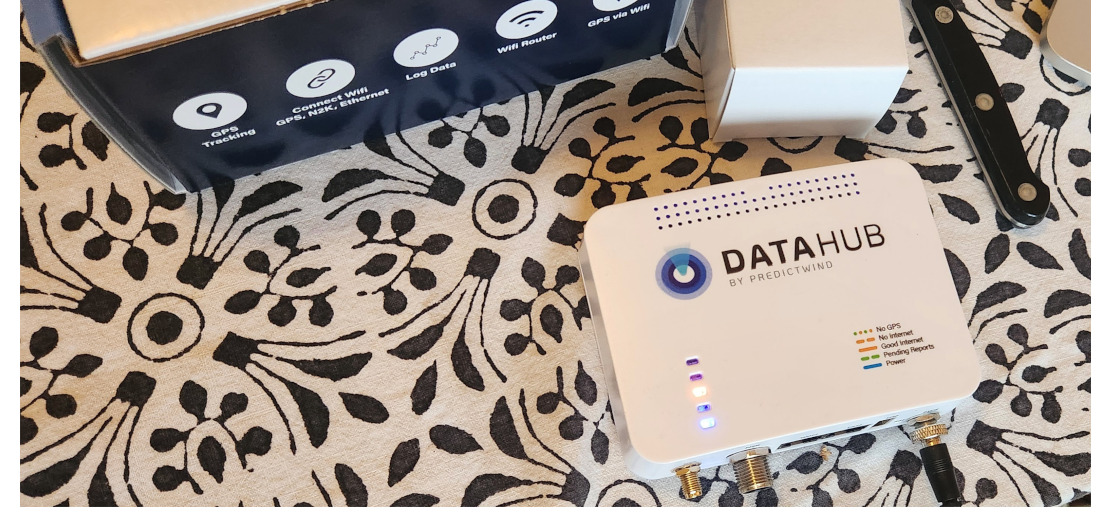
For $300US ($149US on sale), Predict Wind, makers of the best weather and navigation software on the planet, answered the call. They make an interface box that has a DHCP router, connects to an access point over ethernet, Wifi (2.4 Ghz or 5Ghz) or a USB for a phone. It has a NMEA 2000 connection, but no 0183, unfortunately. It claims to translate a number of PGNs (from NMEA 2000) to 0183 over wifi. We’ll see how many, once we have it working.
One Wifi radio is used to connect to the Access Point, the other to the devices on the network (and the contained DHCP). Standard is 2.4Ghz to the access point, 5Ghz to the devices. There are a couple of problems with this. The smaller devices, like my printer and scanner (Alexis, when we bring it on board) only connect to 2.4Ghz and 5Ghz doesn’t have much range. These can be reversed with a software setting, which is what I will do. We’ll connect our phones to the DataHub as the access point for the data hub when we use it for the internet connection.
I will turn off the WiFi on Starlink, so that there is one less WiFi on the boat and I’d like to use the Les Paul SSID for the DataHub. My major fear is how do I turn Starlink WiFi back on? I expect I use the ethernet cable, for which I currently have no device other than the DataHub to connect to it. I can do a hardware reset, if necessary. I’ll learn all of this as the week progresses.
I’ll also turn off Vesper’s WiFi, which will take us to one WiFi for the boat, and everything will be where I’d like it to be. (A USB cable to a laptop is how one can control the Vesper.)
The next problem is how to connect everything up. We have a Raymarine autopilot, EV1, which I recommend. It works very well and transmits heading over NMEA 2000, which we used with Radar to map AIS targets. This combined with target information and GPS allowed us to overlay AIS target on our radar screen, something we’d known about, but never seen. It is very nice.
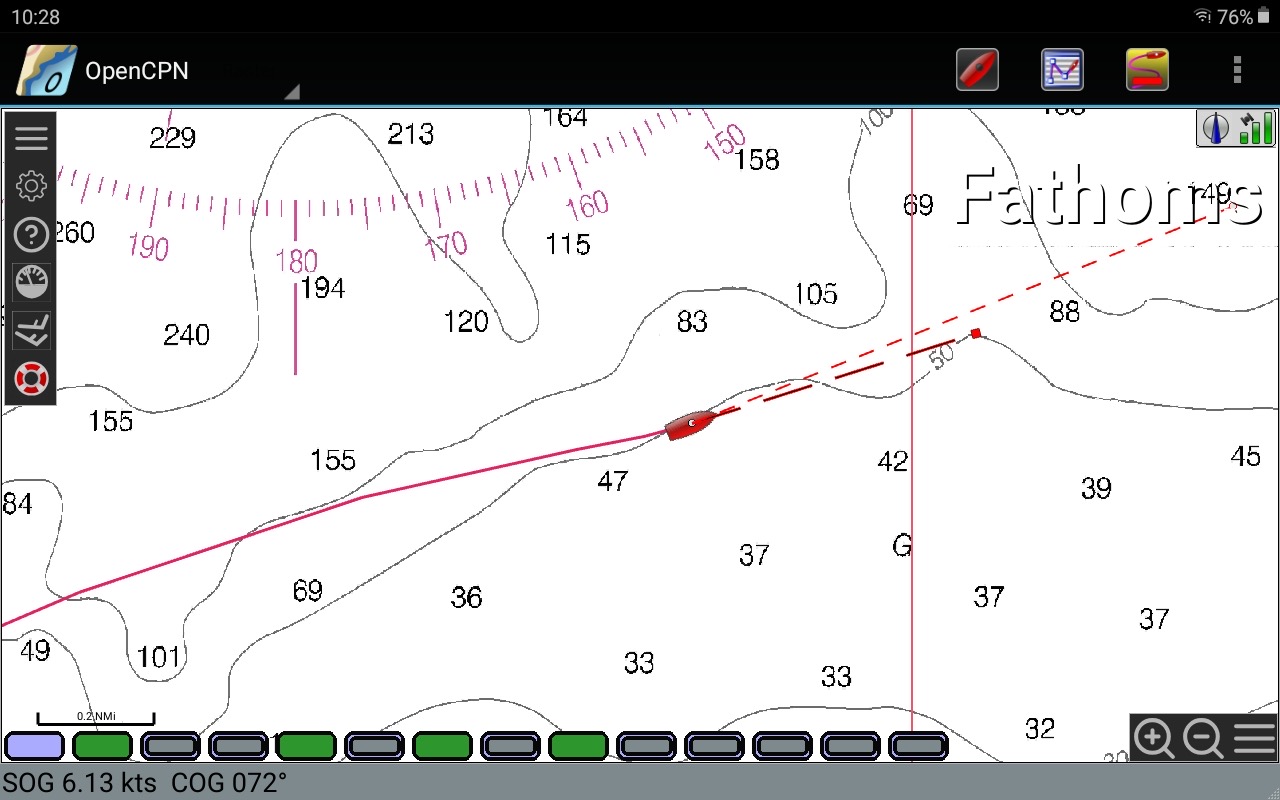
With the Garmin firmware update, this went away. We also used it on OpenCPN to track the course made good against heading. It isn’t necessary, but it is a nice thing to have.
I’m hoping that the DataHub will translate these PGNs onto 0183 Wifi, so at least we can see heading on OpenCPN.
Raymarine’s newer products use NMEA 2000, but they use a different cabling system. (You can think of this in terms of ANSI layers, with cabling being the hardware transport layer.) They used different cables and connectors. I originally thought this was just to be different, but I have since learned it is for backwards compatibility to older hardware.
The Raymarine Backbone has more conductors (wires) than NMEA 2000, this is to allow the older technology to piggyback and to be translated when the signal leaves Raymarine NG backbone. This also means, unlike NMEA 2000, drop (spur) cables do not have the same number of conductors as backbone cables.
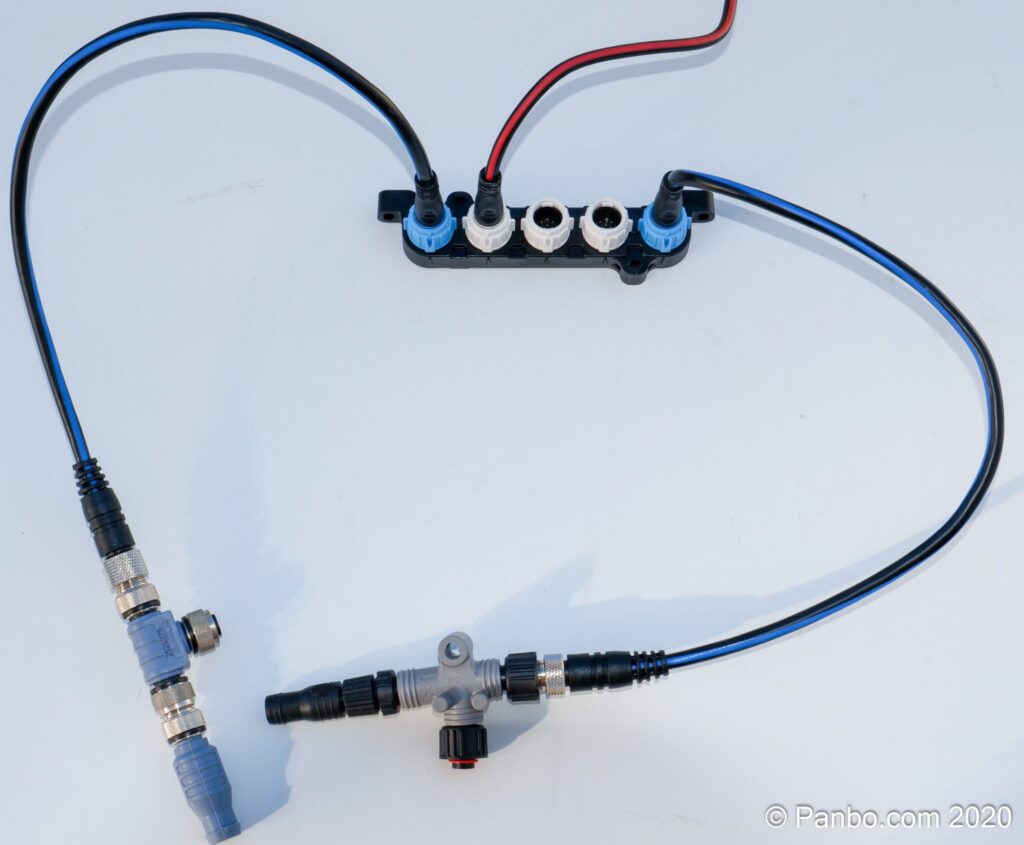
I’ve seen two different ways to connect Raymarine NG to NMEA 2000, one is using a drop cable, the other using a back bone cable. The major difference, assuming they both work, is the number of terminators.
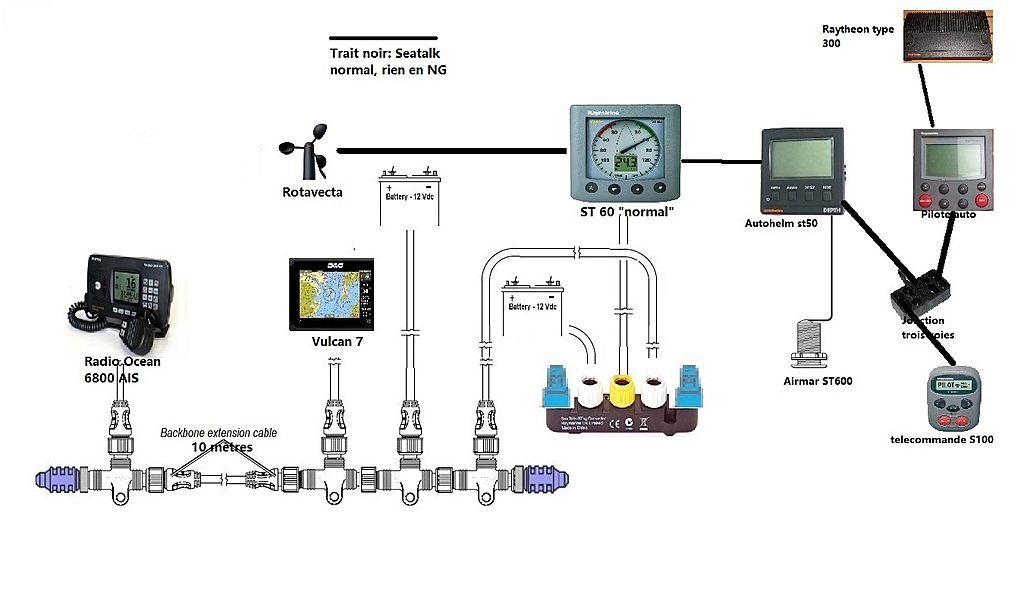
Both Raymarine NG and NMEA 2000 use a backbone, which is a single cable along which devices are connected via Drop cables, or Spur cables in Raymarine parlance. To connect Raymarine to NMEA 2000, one diagram shows a drop connector between the two networks; each network is terminated with two terminators. Another diagram shows a backbone cable between the backbones, with one terminator in each backbone. We’ll see. Tomorrow, is my guess.
Predict Wind says it is best to mount the DataHub horizontally (as opposed to vertically) for the best WiFi connectivity because of the antenna orientation. So I’ll mount it upside down under the cockpit floor in the basement and run the backbone there as well.
Wish me luck.
P.S. Amazon just told me the female terminator will not arrive for another week. I’ll probably try to buy one in town and return the Amazon one when it arrives.
As in all things, I should think before ordering. I could have ordered all of the NMEA cabling (NG and 2000) from FisheriesSupply for less and had it the next day.
