
Port Townsend, 8-FEB-2026 – There is a lot to learn, and a lot of ways to learn it. I installed LiFePO4 batteries in Caro Babbo. The battery was $500. The electronics, another $500. A thousand all up, not bad.
The three house batteries were pretty much dead when I went to the boat one day. Little voltage, and the hygrometer reading was near zero. I had a choice: replace the batteries or upgrade to Lithium as I said I would do. Lithium it was.
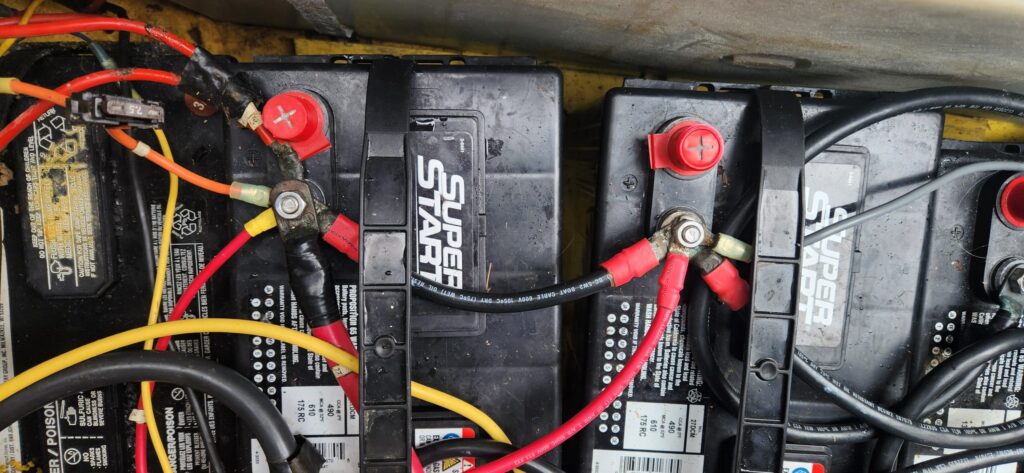
I spoke to Steve Lindsay about how many Amp hours††† I had in the three batteries that made up the house batteries. The batteries only talk about CCA; I didn’t know what it meant.* Steve said the three batteries I had probably totaled about 60 Amp Hours (AH), though I can’t remember if he said a piece or total. I could just replace them all with a single battery.
I spoke to people in the Zingaro saloon who pointed me to the man who knows and tests it all on the web: Will Prowse in Las Vegas. He tests and tears apart Lithium Ferrous Phosphate batteries for his channel. He charges companies to do these tests, though how this differs from a normal endorsement may be a matter of semantics, but his contracts allow him to publish whatever he finds, good or bad.
He appears quite young, good-looking, personable, and speaks well, though he does have certain catch phrases he repeats often… and he has 1.09 million subscribers.
I watched a dozen or more videos on 12 volt LiFePo4 batteries and chose a WattCycle 314 AH Smart Battery with a heater. ‘‘Smart’’ says it has Bluetooth so it speaks to an app telling its state and individual cell level of charge. This is pretty cool, though you can’t instruct the battery to do anything.
A few months ago, there was a firmware error in the WattCycle smart batteries that were installed in parallel. The batteries would not discharge at the same rate. One would dip and then the other. It was supposed to be fixed by now, but I have no plans to install multiple batteries, so I don’t care.
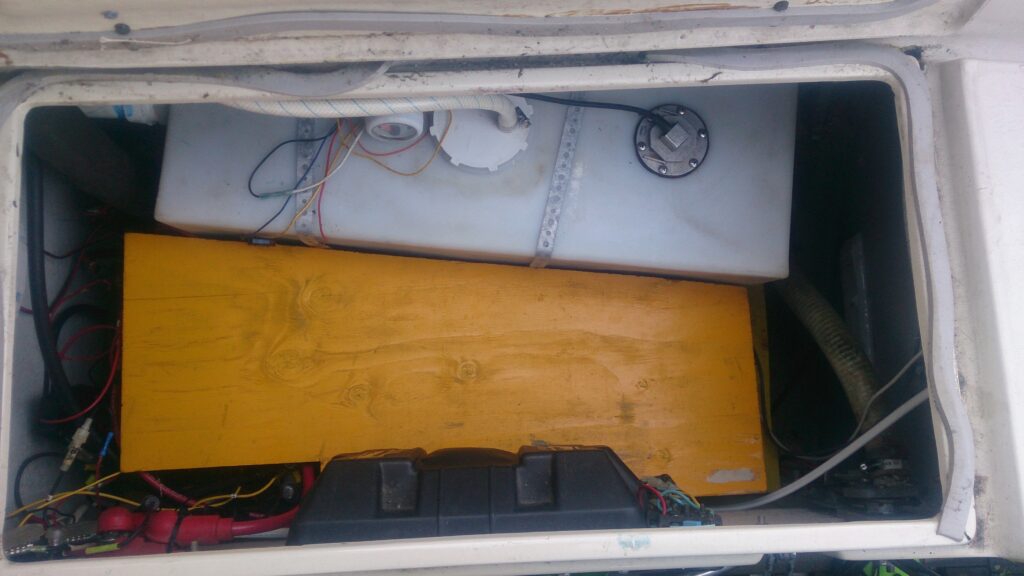
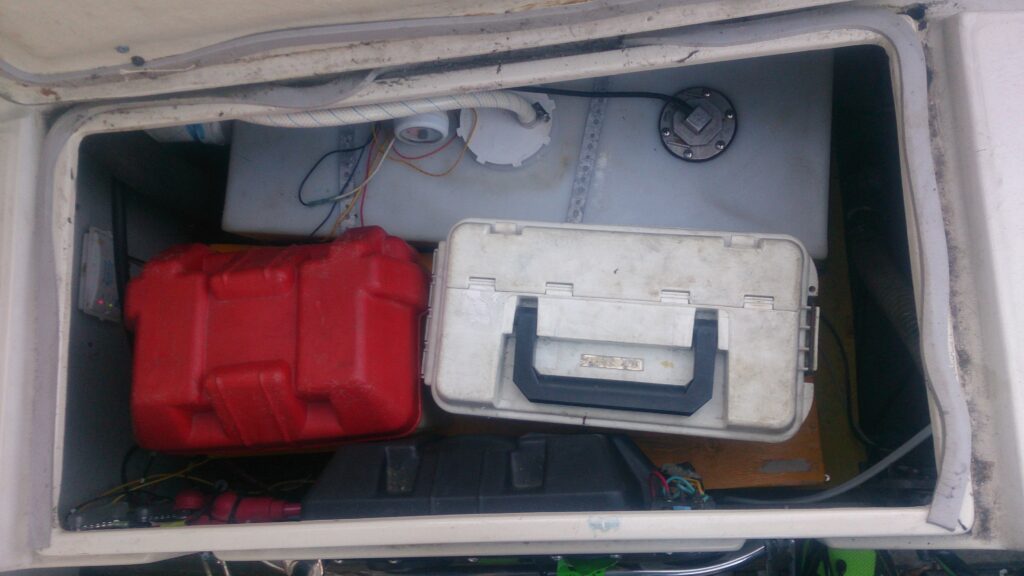
The replacement battery is physically much longer than any of the batteries it replaces and narrower than any of them, meaning I will have to strap it down. The other batteries were jammed in place so they could not move horizontally, and there was a shelf on top of them with tools boxes held in place by the hatch lid, so they couldn’t move vertically.
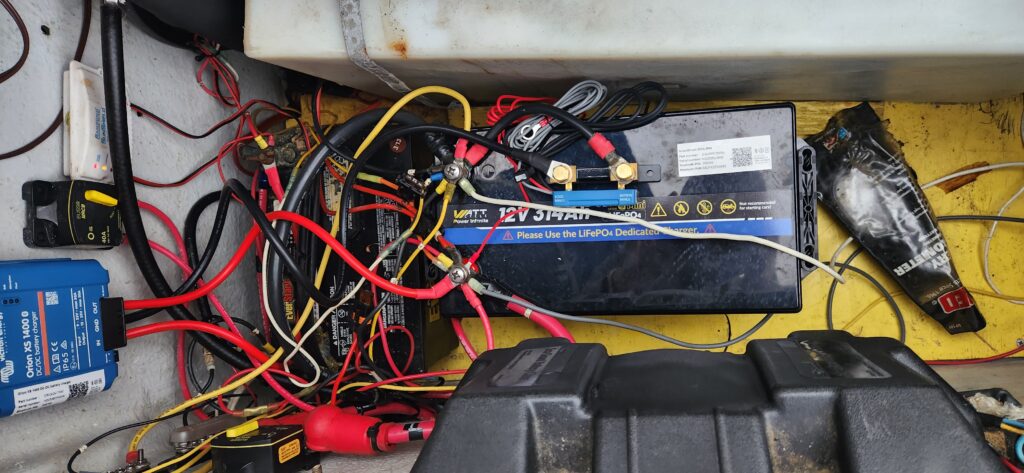
This new battery can easily move horizontally, and I haven’t measured the height for the tool boxes. It is not as long as the previous three, so I don’t know how the tool boxes will fit. I’ll also have to put legs or something on the shelf because the battery is only under a little more than half the shelf. There will, of course, be space under the shelf.
LiFePO4 batteries need a different charging than lead acid.† Lead acid batteries put up resistance as they are charged – literally. You can connect a very large amperage charging device, say an alternator, and the battery will not use all the amperage. It will swallow what it can swallow as it charges. And they are difficult to overcharge. But, it can discharge all at once, if need be, putting out tremendous amounts of amperage.**
LiFePO4 batteries are the inverse. They can swallow huge amounts of power as fast as you can shovel it in because they have so little resistance. This is a problem for alternators, which can short out if they are connected to something with so little resistance. LiFePO4 batteries are easy to overcharge and they don’t like to give up their charge quickly… they can’t, generally, be used to start a car, for instance.
On the other hand, LiFePO4 batteries can discharge the amount of their rated power and be fine, while lead acid batteries can only discharge 50% before they start dying.
I ordered a WattCycle 314 Amp, smart battery with a heater. Oh yeah, you can’t charge LiFePO4 batteries when they’re frozen. A heater should keep that from happening. (Lead acid batteries don’t freeze, at least not at any temperature I ever plan to be at.)
The battery arrived with a 57% charge according to the app, and all the cells within .01 volts of each other. The one surprising thing was that the positive and negative battery posts are reversed from the lead acids I had installed. This worried me when I installed it. I was afraid I’d connect the wires backwards.
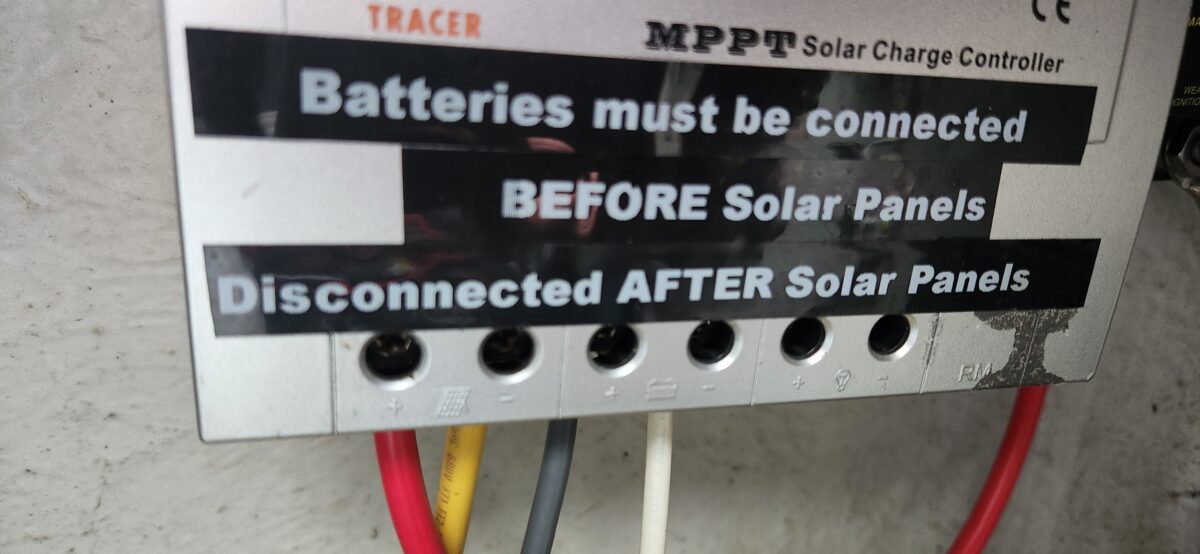
The difference in charging required new electronics. The Renogy MPPT solar charger that I have can’t charge LiFePO4 batteries; I need a DC-DC battery charger to keep the LiFePO4 from sallowing my alternator, among other things; and I put in a shunt so I could tell how full the battery is – I can actually do this through the app, but the other two devices can use the shunt’s info when they are charging.
Victron makes a well-regarded line of electrical components, many of which are oriented to LiFePO4 batteries.
I chose the SmartSolar MPPT Charge Controller 100V/50A, which uses Bluetooth to speak to the app and create a network of Victron devices. The installation was easy, just a matter of reconnecting the wire to the new device. The mounting holes are in different places, though.
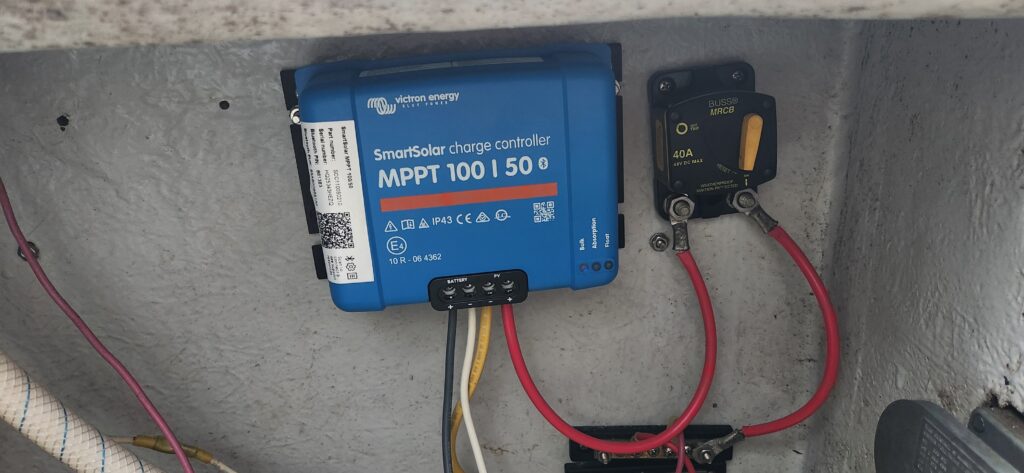
For the DC-DC charger, I chose the Orion XS 1400 DC-DC Battery Charger. This is also a Bluetooth device that connects to the same network. I bought a SmartShunt IP65 – 300A/50MV, which, again, speaks to the network. It was quite easy to install. It currently sits atop the battery.
The DC-DC charger takes its input from the starter battery. This is a little frightening because I don’t want it to discharge the starting battery.
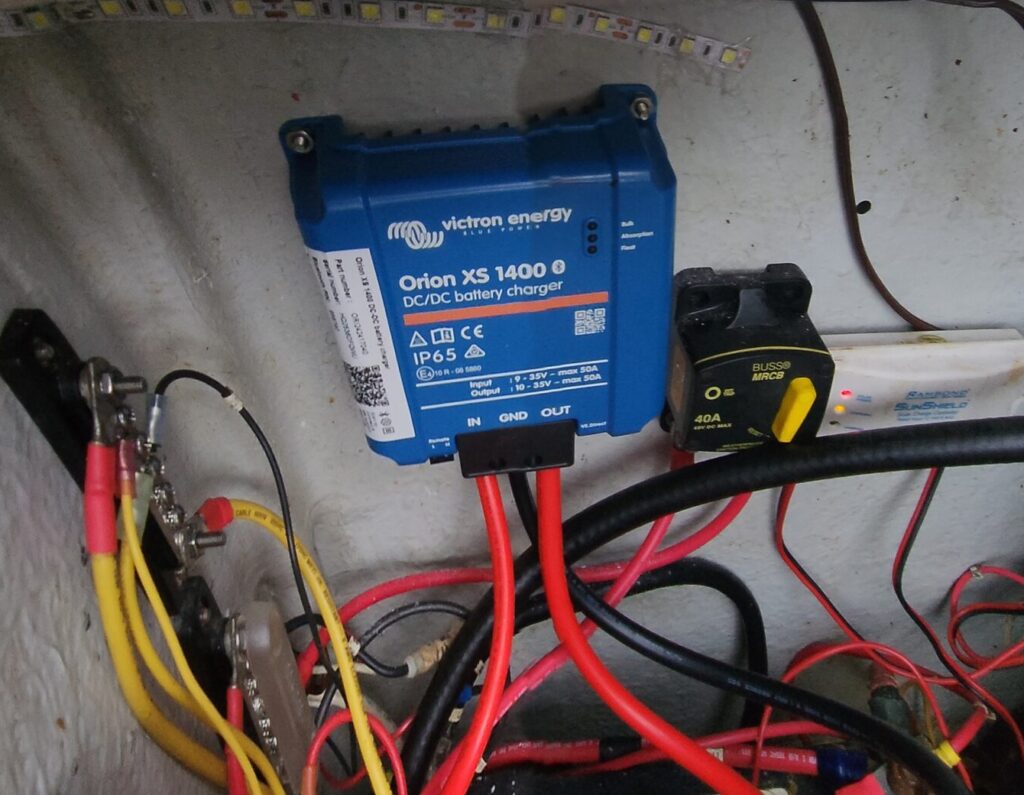
I already had an ACR (Automatic Charging Relay) installed that senses when the starting battery reaches 12.9 volts and then allows current to flow to the second battery. I connected the DC-DC charger to this and found it won’t work because the charger doesn’t have any current flowing from it, like a battery does. The ACR detects this, throws an error, and won’t send any current flow to the second battery.
Okay. I hooked the DC-DC charger to the starting battery. The DC-DC charger has its own logic to decide when to take current from whatever battery (usually the starter battery) it is connected to. Like the ACR, it works on voltage: two different voltages and a delay.
First, every parameter in the Victron, and this goes for every Victron device I’ve bought, is changeable. The standard voltage to start taking power from the starter battery is 14.0 volts, vs 12.9 for the ACR. I can pick whatever voltage I want.
Victron says it is to give the starting battery time to recharge after starting the engine. I realized that is true, because once the DC-DC charger starts, it will take all of the power, nothing will flow backwards to balance the two batteries as if there was a battery connected there. It also lets you set it for a second lower voltage with a delay, for the same reason.
Victron is made in the Netherlands (actually made there?), so it pays attention to the Euro standard for cars. Euro 6 is now available. It and Euro 5 lessen the voltage of the alternator when there is no draw. This means when you start the car, if the battery doesn’t discharge much, the alternator will not put out any voltage above the at-rest voltage of the starter battery (12.3 V). It will put out more if there is a draw, like a DC-DC charger drawing power.
How to tell if the engine is running? You can buy or make a clever switch that senses when the engine is running from its vibration, or you can put +12V to one of the connectors on the DC-DC charger from the ignition switch, or ground the other connector. Either will tell the charger the engine is running, or you can put a manual switch across the two connectors.
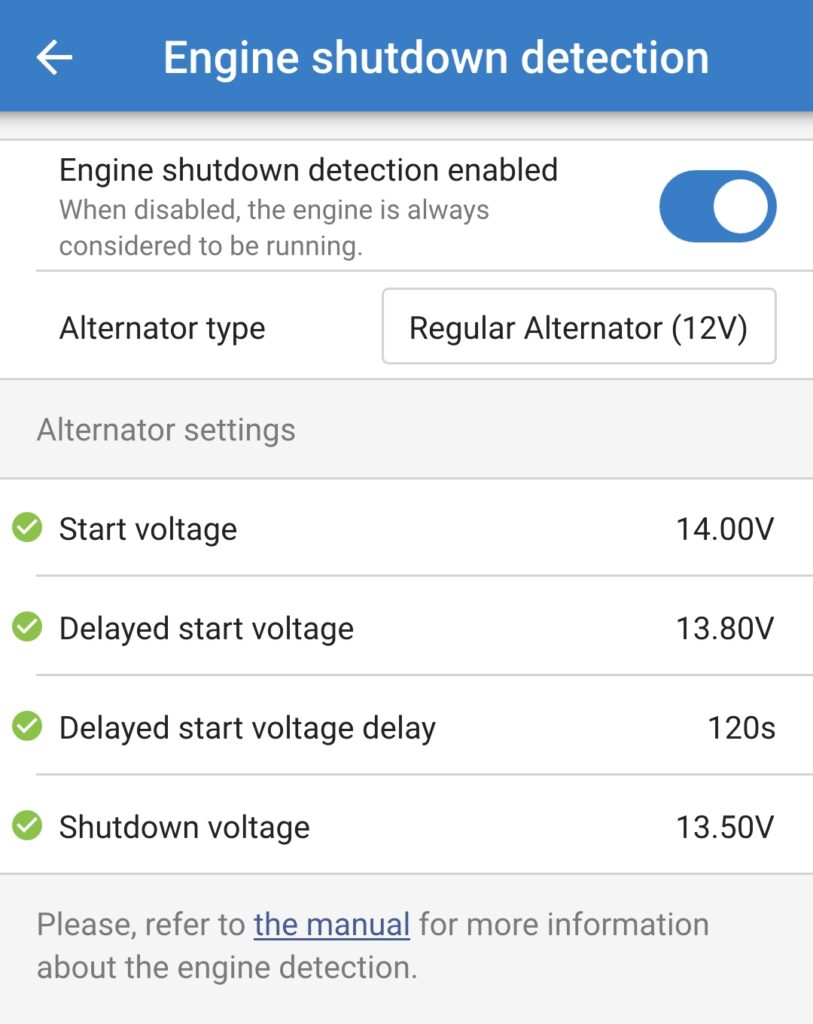
To use any of these methods, you turn off the engine voltage logic.
But what happens if the switch is on (or +12V or ground) and the engine stops running? In that case, there is a setting to turn off the charger when the starting battery drops below a certain, user-specified value, so there will still be enough power to start the engine. Or so one hopes.
This value was set for a 24V battery and did not reset when I set the battery to 12V, so the charger wouldn’t work when first installed and the engine was running. I did see the value and how high it was, but it didn’t click what it meant. I was talking it over with Aziz; we went through everything; he just declared it was a setting. I went home, read the manual again, and realized what needed to be done. I waited until morning to do it, and it charged immediately.
I also reset the maximum amount of power it will draw from the alternator. It was set to 50 amps, more than my 40-amp alternator can produce. I set it to 35 to give some room… I’ll rethink this as time passes.
I also hooked up the shunt, putting it between the house battery negative and the common negative of the DC-DC charger, leaving everything else as it was when it was connected to the lead acid house battery.
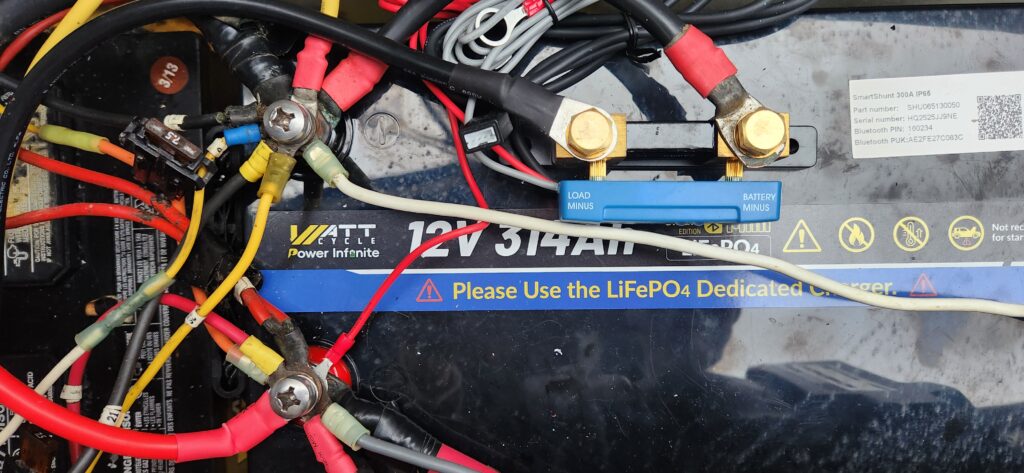
Connected to the lead acid battery were six leads that I connected across the three house batteries. There had been more, but I removed those to bus blocks. These are things that I do not want to go through the house circuit breaker box. Things like bilge pumps, VHF radio, and the like, as well as the solar charger and the DC-DC charger.
I will add an additional pair of bus blocks to move these, now especially.
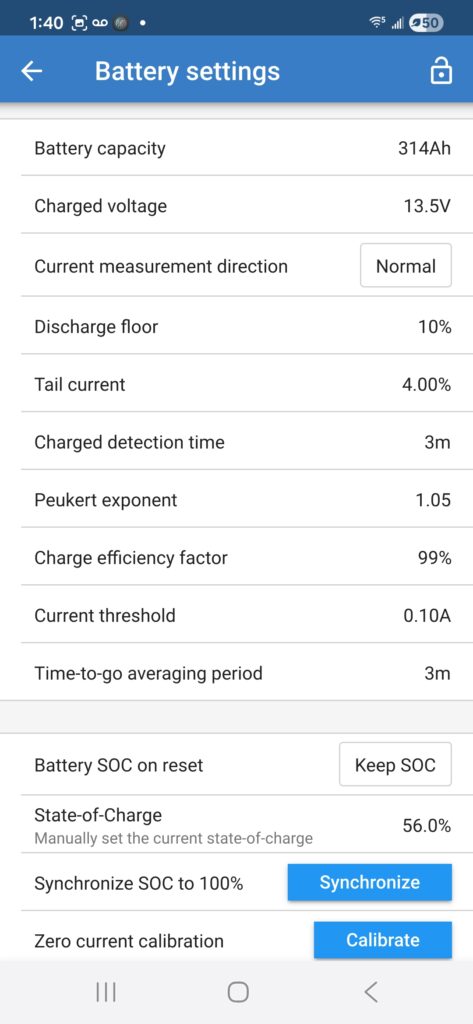
The shunt measures the current in and out of the battery. Once you set how much is in the battery and how much capacity it has, it can tell how much of the battery is left, or how much time you have left at the current draw, or how much time until the battery is fully charged.
It also connects to Bluetooth and can become part of the network of Victron devices, informing the chargers of this info. (The other devices use this to make decisions, or so Victron says.)
By leaving all those connections between the shunt and the battery, there was no way for the shunt to measure the current in or out. It took a full day for me to realize this.††
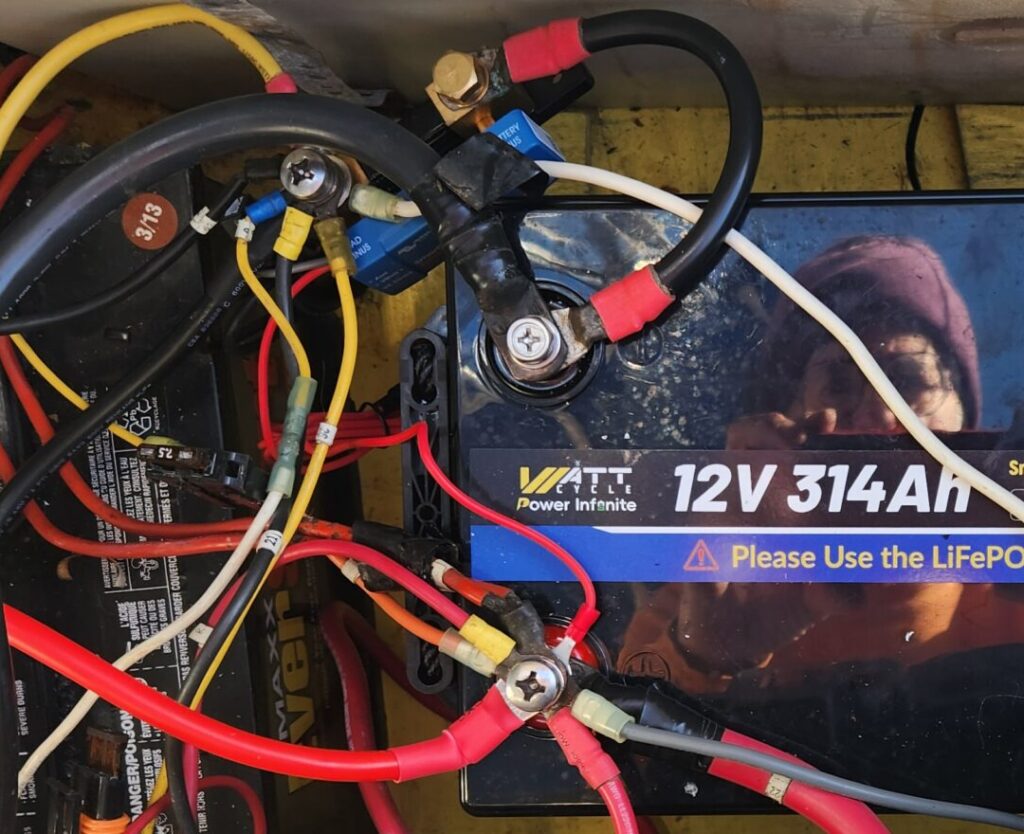
Having to connect everything to the shunt makes the cables untenable. I’ll need to get the bus bars installed in the next week or so. We move the boat to Olympia in the next three weeks.
The battery has huge capacity. It will last a long time and take a very long time to charge. It is charging on the solar panels. It will take around fifty hours to charge the next forty-five percent. If we were living on board, I would move the panels so they weren’t shadowed as they are now.
At 20 amps, which is what my alternator produces at idle, it will take five hours. If we motor for any distance, it will all be charged.
I still need to remove the ACR. I think I’ll leave the 6 gauge wire for the house battery in place. I don’t know why at the moment. It will just be cable threaded to the battery locker (startboard cockpit locker). I don’t think any power will be generated through it through induction.
Of course, it is impossible to work on one project without stirring up trouble. When I started the engine to test the DC-DC charger and the shunt, Caro Babbo had a dry exhaust. There was no seawater moving through the heat exchanger. After disconnecting hoses, I discovered the 90-degree fitting from the exhaust elbow was apparently clogged. Without a hose attached, it gushed water, and all is well, but I never found what was blocking it. In Homer in 2024, we had the same problem: exhaust soot. I don’t know if this was the same thing. If I have time, I’ll take it apart and see.
Tomorrow, I install the new galley water pump, and then the oil pressure switch and sensor. That gets me through the major things for the season.
Jennifer says she’ll start the cushions for the aft cabin. I’ve bought kerosene for the stove, and I will write a piece on keeping burners clean and usable across the seasons… Forever? Yes, I know it took twelve years for me to figure this out, but I’ve never found anyone on the web who figured it out either.
Thanks for reading and being our friends.
P.S. If you find something I’ve written that isn’t technically correct, please tell me and I’ll fix the post.
††† Amp hours are misleading, because 10 amps at 24 volts, is twice as much power as 10 amps at 12 volts. Watts, which are volts times amps, are a better indicator in my opinion.
*I eventually learned it meant Cold Cranking Amps.
† There are multiple types of lead acid: Flooded, Sealed, and AGM, to name three. The chemistry is pretty much the same for all three.
** Back in the eighties or nineties, the US military was experimenting with rail guns to shoot down things. They used induction electromagnets that required vast amounts of power for a split second. This was done on an island somewhere in the Pacific. Rather than create a huge power generation station, they connected up something like 1200 car batteries. It worked and it was cheap. And, no rail guns didn’t work for shooting down planes, missiles or satellites.
†† The shunt works just like an ammeter in old Chrysler products, before they, like everyone, went to idiot lights – or now just a single check engine light.

Oh man – the complexity!
I’ve heard the capacity of automotive starting batteries is a pathetic 25 Ah.
Usually specified as some sort of Reserve Capacity expressed in minutes,
based on running some unknown load, like headlights down to 10.5V or so.
And you want to use 20% or less of that capacity for maximum number of cycles.
Don’t know if a Deep Cycle RV battery is much better.
But it is amazing how complicated the LiFePO4 solution is!
We’ll find out. So far, the battery has charged to 99%. Perhaps it has gone to 100%. It is very cloudy here, and AIS draws 5W. In any case, all looks good so far.
I’m trying to get the shunt to match what the battery says. I’m learning as I go along.
You can read the manuals, if you like.
Deep cycle RV batteries seem to tolerate more cycles, but running it down below 10V spells disaster, though it shouldn’t.