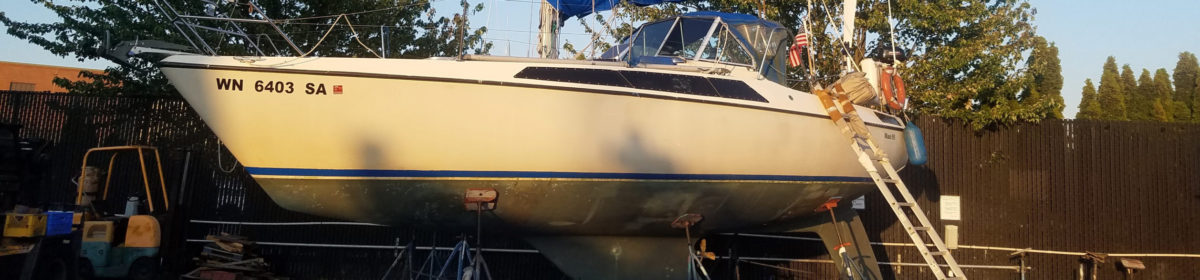
North East of Yokohama, 2-MAY-2026 – Let’s start with Caro Babbo: She’s in slip 132 in Boat Haven in Port Townsend. We can keep her there until October first, as long as we don’t leave the slip for more than three days. Then they will cancel our agreement and give the slip to someone else. No, they didn’t tell us that when they offered the slip. I found out when I went to the office to confirm things. I raised it with Kristian and told him we should each think about it, and I did. I expect we’ll keep it there until we want to go sailing, and then won’t bring it back until October when we return to Point Hudson and slip 28.
The engine starts without bleeding, the throttle still sticks, I need to work on that, but that is everything that must be done. The want to get done is unending, as it always is, but that’s the way boats are.
I expect we’ll head up into Canada for a while and then return. We’ll do the south sound either before or after we go – perhaps both? Unlikely.
The many things I did around the house have held, mostly. Some needed to be done twice, others need to be repaired again. The hot tub is leaking again – I believe this is the plug in the bottom, again. The Celica window still isn’t right. I worry that the pulley I put on has fallen off again, but now that I know how to do it, I can repair it easily. The relay for the top hasn’t shown up. I did get the carrier’s website to answer once, and the item was waiting for customs in Paris. Strange, but it might come from there because of the lower import duty. I dunno.
In preparation for this cruise, Jennifer bought a boatload of dresses, kept three or four, and a few tops… and shoes? I bought three pair of trousers. I have four shirts I bought a couple of years ago, and we’re ready to go.
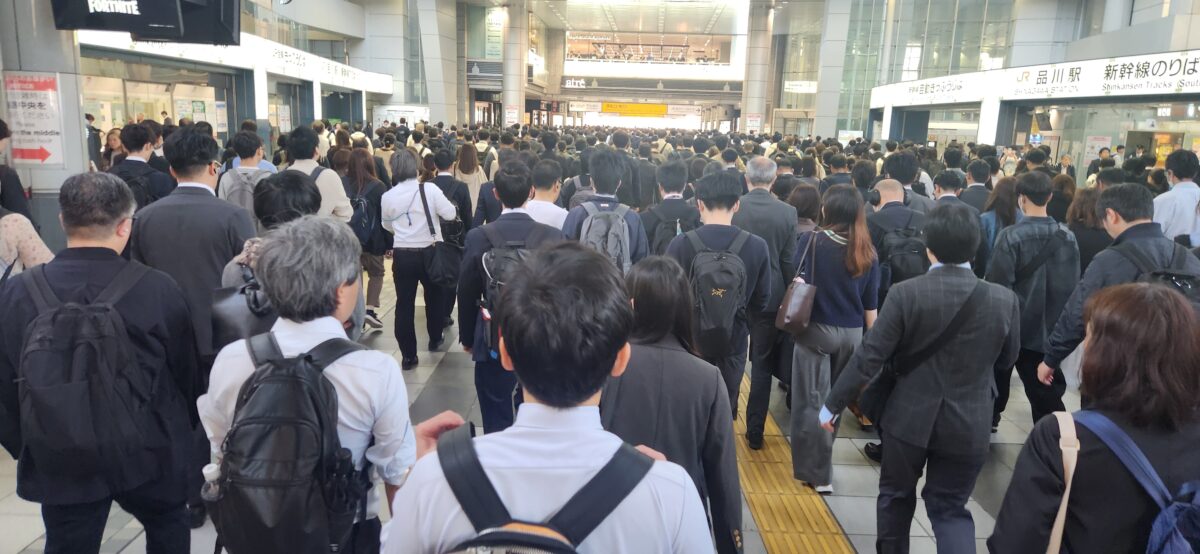
We made a mistake in charging up the IC cards we bought. Mass transit is much cheaper than we expected, as is almost everything. But other than that we are doing well. We don’t know how much English everyone speaks because we speak little to everyone, and then are surprised when they speak to us in English. The amount of English varies from a few very accented words to perfect English.
Everyone is very polite and bows a little and is very nice when I bow back or bow first on meeting.
Jennifer picked up a few words before we got here… I studied for a few days, probably more than twelve hours, and nothing stuck; I am much better at remembering written words than purely verbal.
Jennifer, who generally does the navigating and picks places to go, this time said she’d just like to wander, as I normally do, and pick places to sit and eat or drink coffee.
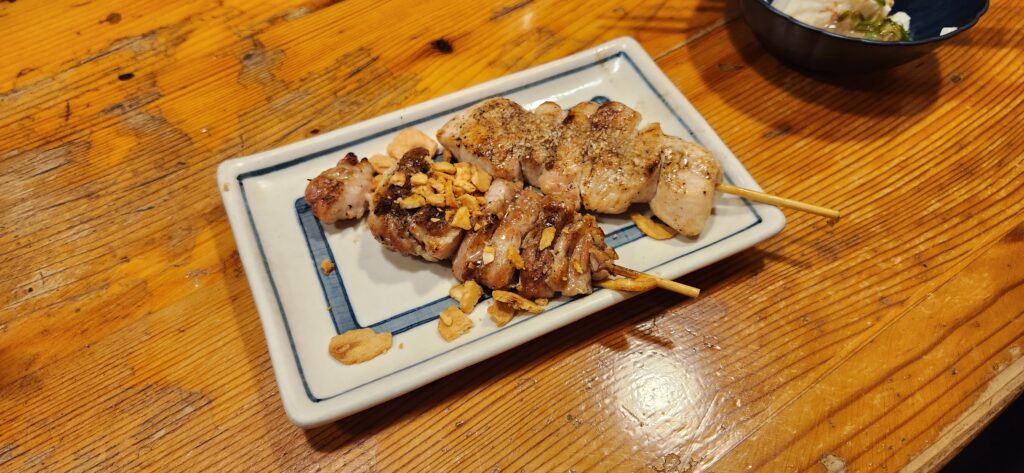
The first night we were in the Shinagawa part of the city, where people live. We wandered and picked a very local Yakitori place, where the waiter gave us an iPad to order from. We thought that was very nice. Then we found every place did, and many of the locals ordered that way as well.
The place was straight out of a Japanese TV show we watched called Midnight Diner. The food is cooked to order on a gas grill and served immediately. We ate lightly; the bill was $24. Very cool. I had a beer, Jennifer: soda water.
The next day, we continued our mass transit odyssey: Google Maps is fantastic. It picks the trains, recommends where to sit, etc on mass transit. Jennifer also ordered bullet train tickets to and from Kyoto. We stayed near the train station in Tokyo and toddled over the next morning. The train station has many, many drink (beverage) machines, one of which brews coffee. We watched a woman choose a cup; the machine said it could take up to 90 seconds, keep track of your train. Each machine has multiple B/W video cameras, and we watched the process happen, including putting the lid on the cup. We tried it.
First problem, we couldn’t get our IC card to work, so we used cash. The machine made change, and off we went. Jennifer made coffee, only 45 seconds this time, and I made hot chocolate… only 25 seconds, then off to board.
On the outside edge of each platform, on the track side, above our heads, is a carriage number, telling us where each car will stop. On the platform in a painted waiting area is a drawn chute. The writing is in English and Japanese. There were people lined up already. We stood in line after figuring out from the diagrams posted whether our seats would be at the front or back of the car.
We got on, sat down, and travelled on a limited express train: three stops from Tokyo to Kyoto. The train itself feels like a TGV in how it moves. (I always rode first class, which was very different than this train.) In the cities, the train moves like every other train, at a non-surprising speed. As we leave the city, the speed increases and things start to move by very quickly. There is no real experience of speed, it’s just that buildings that are quite far away change perspective much quicker than one expects.
The route the train travels is also different than the US east and west coasts, where most of my train experience is. Those trains were built along the shore where they could pick up goods from ships or transfer to ships. Riding in those trains gives one a view of the water that is difficult or impossible to get anywhere else. On this train, we were within a few miles of the water, but no view was possible. We did see, like much of this part of Japan, Mt Fuji. It is a spectre, perhaps a god overseeing the country.
It was a nice day when we arrived. I had picked a Hyatt Regency, which would have paid for a cab, but we walked the 35 minutes instead.
We could see out the windows of the trains that the smaller towns and perhaps smaller cities, Kyoto is the ninth largest at 2.5 million, look are very different. Everything looks, to this American, like a small town in upstate New York. Small houses bunched together, old streets that can be very narrow, no look of flash or modernity. Walking across Kyoto felt the exact same way. The hotel was not in downtown. On a map it wasn’t in the heart of downtown, but the density of streets, made me expect tall buildings cramped together. Instead, Kyoto was quite open, with many one and two-story buildings and a large museum across the street.
The hotel was an international hotel, with the level of personnel and international staff that one expects – no Americans on the staff that we saw. It was Japanese and Indians.
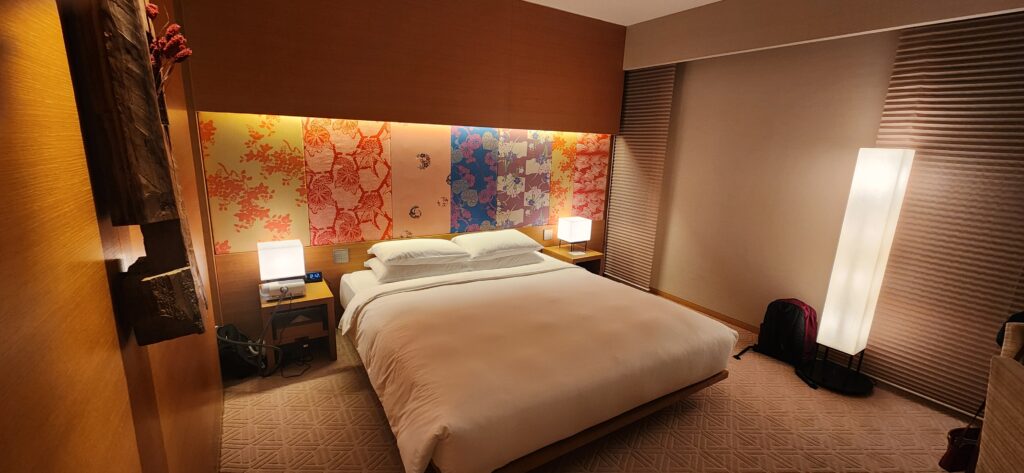
We ate room service dinner. We stayed on a deal from American Express: $300 credit card credit and a $100 hotel credit (which can only be used for food, actually). The restaurants looked very nice, but loaded with carbohydrates, and we’d be eating with tourists from around the world. We ordered what looked best: Burgers, vegetables, salad, and bottled water. No Alcohol, no dessert – $90 USD. It was quite good. The room service person just brought the table into the entrance way of the room and left. I needed to set up the table, arrange the chairs, get the hot food out of the carrier under the table, etc. Very different than what I expected and have experienced.
We had a lovely time in the room.
[End Part 1]
A note in the food on the Delta flight and the attendants. The food on the flight was the worst food I have ever had on any flight with any carrier. The lamb was mostly grizzle, the garbanzo beans and green bean mix was terrible, the plastic package piece of bread was, well, it was what bread that is packaged that way is, terrible. I tasted all of the food, but ate none of it. The blondie, which also came in a plastic package, was fat, sugar, and flour. I guiltily ate that.
The flight attendants on my side of the plane were snide. I wanted sparkling water and saw they had litre bottles of Pellegrino. I asked for Pellegrino. The attendant made some comment about me asking for Pellegrino.
Now, please understand, I have 1.3 million miles on Delta. I have flown a lot on this airline over the years – though this is the first trans-Pacific. I always flew on codeshares with partner airlines or other carriers entirely. This was a disaster.
We did meet a very nice attendant in the aft galley when we went there to get more to drink and some snacks.
The American man doing the announcement, I would have thought, was high, or kept getting the sheets of paper he was reading from confused. He would read a paragraph and then pause for 30 seconds or so and continue. This was the same for all of the announcements. The woman speaking Japanese read her announcements in a manner that one expects: practiced and with an even voice.
I hope the feds do not allow another merger. If this is what the business looks like with this few airlines, I can’t imagine what will happen to the service when the number of carriers drops still further.
