
It took a year for me to rediscover this…
Port Townsend 18-NOV-2025 – I’ve been thinking about this for a couple of days: thinking about writing a blog – it’s been a long time – thinking about what the topic should be, and thinking about the topic. I kept losing what I’d write about the topic. Losing what I’d write isn’t the result of the stroke. I’ve always lost things I need to think about. I once forgot my ATM code for four days in Vegas where I was teaching a course. Fortunately, I had a checking account (remember those) where I could cash a check (remember THOSE).
I want to write about reminiscences. I’d like to start off with how much time I’ve spent on a boat. This started when James and Jeremy came to visit, and James asked how much sailing I’d done on Caro Babbo. I initially said 16,000 miles. I texted him two days later to say I was wrong; it was at least 26,000 miles on Caro Babbo. He said he knew the 16K was low.
As I let that wander ’round in my head, I thought about how much time I’ve spent aboard a boat – this came about because I was thinking about how little time I’ve spent at my domiciles over the past bunch of decades.
I’ve had a boat for the past 22 years.† I spend a minimum of three months each summer living aboard. Some years less, other years twice that amount, so let’s say three months is an accurate average. Three times twenty-two is sixty-six. That’s five and half years.
I’ve spent five and half years sleeping aboard a sailboat I own. That amount surprised me. The first ten years were in a T-Bird*, a double-wide coffin, I’d tell people. I spent a lot of time learning on that boat and a lot of time sailing.
In those days, and for a good number of years later, I worked.
On the T-Bird, I had a mooring in Mt. Sinai Harbor. I would ride a bike to the Port Jefferson Library, where I had electricity and internet, and work. Six miles each way, up and down. It built muscle. I was surprised to learn that the route I took most days was a training route used by competitive cyclists. At the end of one summer day, I left my keys on the library counter and had to ride back for them. It was easy. You can turn your body into a machine that does what you tell it.
The first summer I spent largely on the boat. I had just been swindled out of a company that I had bet everything on and dumped by a woman whom I had done the same. I made a deal with my dad (Babbo) that if I got his boat ready for the water, he’d let me live on it that summer. I did both, and reacquainted myself with sailing, taking my sister-in-law, Cathy, with me whenever I went out. I generally worked aboard, telling clients that someone was mowing the grass whenever an outboard went by. The next year I single-handed and didn’t invite Cathy anymore. I’m ashamed of that and embarrassed.
The years at the library were in the town where I went to high school. I saw some of the students that I knew in High School and a teacher I knew then.
One woman I liked a lot did not, apparently, have good memories of me. I was shocked when she was cold and kept away from me. Another, very nice woman who was very shy in high school was still as shy as an early fifties woman and the high school teacher told me that the teacher that I loved had died in her early thirties of breast cancer. Thanks to computers, the teacher was still listed as alive and well and living at her last address.
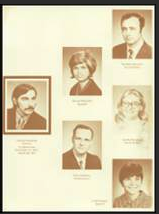
Judy Neige was gorgeous, to my memory, and had a wonderful husband. I would see the two of them outside of school, and for a few years after I graduated. Her husband told me Little Richard was gay and wore tons of makeup. The makeup I believed; gay I did not… well, I was young. He called Judy, Kit. I asked about it, and he said it was short for Kitten. She was seven or eight years older than me, and he was about the same. Time passes quickly when you’re old, but it passes just as quickly when you’re young and building a career. It was twenty-some odd years later when I started looking for her, and she’d been dead for close to twenty years by then. I thought of looking up her husband, but never did.
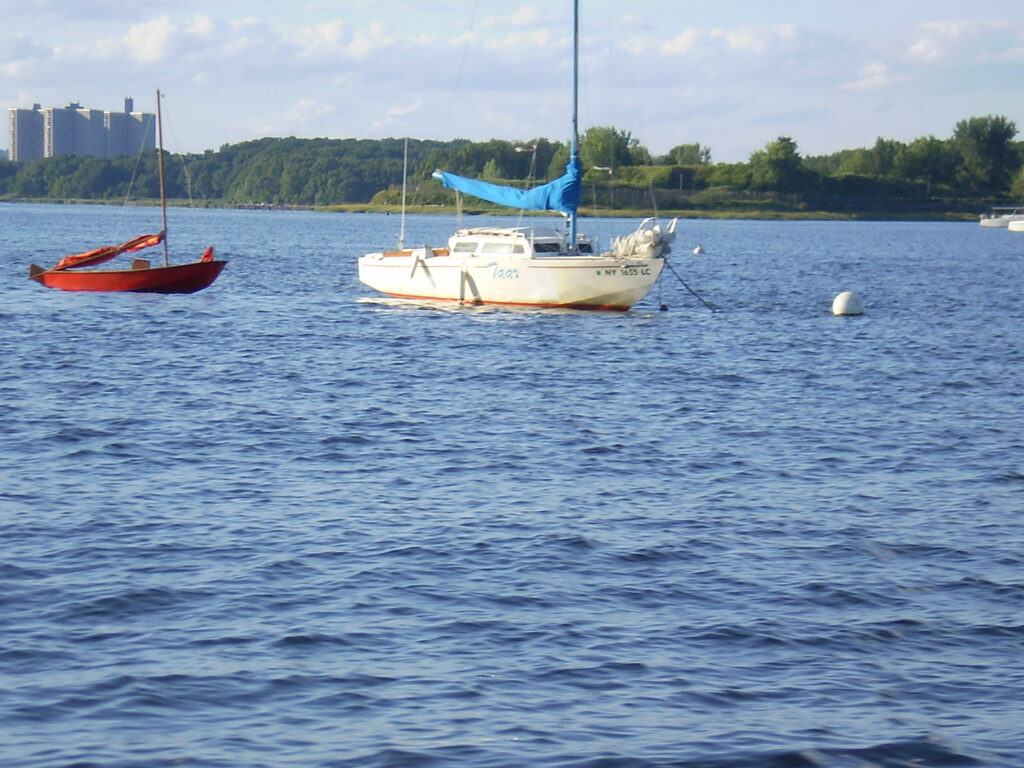
During those first few years I generally just day-sailed, and took a run across the sound and once a trip to NYC to race on someone’s boat. Taaris was 26-feet long (25 foot nine inches to be precise – this will be important later). I towed a ten-foot Mirror dinghy with me wherever I went. My dad had found the plans and built two or three Mirrors for practice and for his grandkids. I pulled one all over the place. I was single; well, I wasn’t married during those early years.
Then in 2005 I met Jennifer and everything changed. Within six weeks, she had traveled to Amsterdam with me to see my dear friends there. From there, onto the boat. Jennifer had no interest in day sailing; she wanted to go somewhere, and go we did. The next six summers I would move onto the boat and live alone for six weeks. Then Jennifer would join me for the next six.
Some years? Most years? She would meet me in Boston and sail back with me.
Jennifer sailed for the first time one afternoon on a breezy day. My Dad joined us. After an hour or so, he decided he’d had enough. Sailing was something he wanted desperately to do. I’d made the boat seaworthy; he came with us, and then decided it wasn’t for him. He’d come once before and had had a good time. It was very flat water.
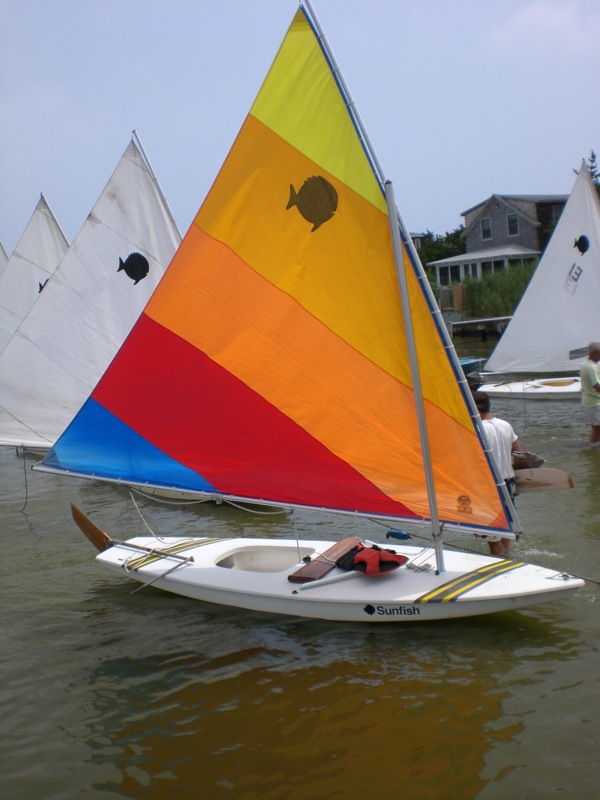
I started sailing a Sunfish at Tuscarora Boy Scout camp when I was 13 or 14. It was transformative; I loved the idea that one could use the wind to go anywhere, even into the wind, sort of. I told my dad, who helped find plans in Mechanics Illustrated for a small sunfish-like boat. I built it across the summer after my freshman year in high school. I got pretty good at boat building and with advice from my dad and no real experience on how much was enough, I overbuilt the boat and left off coaming that kept the water out of the cockpit.
But the boat sailed, and after some minor refits, I sailed it for the rest of the summer.
I had a girlfriend that summer. We sailed where we could, and I sailed near shore. I was an outgoing kid, who embarrassed himself constantly. In the years that passed, some of the things I did embarrassed me more than they had then; as time passed, I realized I was just a kid learning his way through life.
When I was fifteen, my dad saw a Star sailboat for sale for $500 somewhere in Nassau County. He convinced me I should buy it, and off we went. Where I would get $500 didn’t enter into it. He and my mother lent me the money, and I worked it off by getting a job at Whites Department Store. We also bought a beer keg for me to use as a mooring buoy, and at some point a mushroom anchor, 25 feet of ½” nylon rope, and 25’ of chain.
I never removed the anchor at the end of the season, and replaced it each spring. Life was very different in the late 1960s. I was 15 years old when I got the job at White’s. No Social Security number was required, and I made $1.65 per hour. I learned about car parts and thievery, riding 100 mph on a Norton motorcycle and people from different parts of Long Island. I didn’t learn much about work ethic besides what I already had, but I did learn that keeping busy and looking like you earned your money was important.
I learned how to run a tire machine to put on and take off tires, I learned how to unload a truck full of bags of charcoal briquettes.
I was asked to unload a tractor-trailer of bags of briquettes and take them to whatever department they belonged.
Whites was nothing but a big retail space with concessions. Each department was a separate concession with its own managers and owners. I hadn’t thought about this for 56 years. Why was I unloading charcoal briquettes? The truck driver had the same question.
He was a very colorfully dressed black man who drove the truck. He had on a yellow shirt, green trousers, and brown shoes. He was wearing a colored scarf (I can’t remember what color) around his neck inside the collar of his shirt. He had on a stiff, narrow-brimmed hat.
When I showed up to unload, he wasn’t happy because he’d be pitching the bags to me. Someone else, a manager, I think, told him he’d have to do that part of the delivery. He wasn’t happy.
With his instructions, I placed a flatbed cart, then kind you now see at Home Depot, behind the truck. He told me he’d toss me the bags – I can’t remember how big they were…10# 25# – to me. He tossed the first one, and I stepped into it. The bag exploded in my arms, covering me with black dust. He didn’t laugh. He wasn’t amused. He told me I had to sling the bag into my arms the way he slung it to me.
We worked for an hour or so unloading the bags. I made multiple trips. When we were done, he left.
I had a friend, Bob Pethick from Boy Scouts, who would sail with me on the Star, Bajan Star, #1922, built in 1940 of wood, then glassed over. She was wet-sailed, so she had bottom paint on when I got her. Her trailer was the frame of some 1930s car with (then) big 17″ spokes on very narrow tires. One of the tires had a chain pattern for a tread; another had writing that said Dunlop. The front wheels turned because the tongue activated the steering mechanism; the rear wheels were attached to the live axle with that big ham of a differential. It used inertia brakes that pushed the master cylinder to activate the big drums.
I was a bit of a novice when I got the boat. The only sloop I had ever been on was a 24’ owned by my junior high biology teacher, Mr Doloph, for one day, and with Mr. Ickes, my high school math teacher, but I’m not sure that was a sloop.
A Star was an Olympic-Class racing boat. Caro Babbo’s designer was an Olympic Star racer, so the circle closed a little bit.†††
The boat had no motor, so we’d sail it out of the harbor and sail it back. She was 23’ and had 295 sq ft of sail. She was designed for Long Island Sound, and sail she did. She’d move on wind you could just barely feel on your face, with a huge mainsail and a small 90% jib. She was narrow, had 900 lbs of iron bulb keel that drew 3 ft of water. Bob and I would leave in the morning and come back in the afternoon. I learned how to sail and dead-reckoning navigate, all through books and trial and error, how I have learned everything I know.
My dad got tired of waiting for me to thread my way through the moorings and bought me an engine to mount on the transom of the boat. The motor, a small two-cycle, had been won in some sort of lottery by the brother of a girl from my high school. I thought this was an affront to the spirit of sailing and never mounted it. It would take an hour some days to sail from the mouth of the harbor to the corner in the back by my mooring.
My dad built a dinghy for me out of a four-by-eight sheet of plywood and some one-by-twelve shelving with fiberglass taped seams. I would paddle that out to the boat and paddle back in.
I was kind of stupid in those days; that wasn’t the reason girls liked me. The fairleads to the mooring cleats would wear through the lines to the beer keg and the boat would float loose. It would take me a day or two to find it floating in the harbor.
When I was 16, there was a girl, who the summer between my sophomore and junior year, had water skied naked across the sound. To my adolescent imagination, this was the height of sexuality and daring. She was a tall, thin, attractive girl, who didn’t seem too embarrassed by the revelation of it.
The summer following my junior year, I dated a girl who was gorgeous and a year older than me. We’d go sailing, the days neither of us was working, in the light LI Sound winds. Joan would take off her top, and we’d sail around the Sound. It was my wildest fantasy come to life. We’d spot some larger boat in the distance and chase it down. She’d put on my button-up shirt as we got close.
We’d generally speak to the skipper about his boat, where he was from, and where he was going. I never saw a woman skipper in those days.
Starting at 9 am, when the air was cool and light, we would ghost out of the harbor and return mid-afternoon.
By the next summer, Joan was gone and there was a new girlfriend – she was gorgeous in a different way… I was stupid, but now in the ways of women – or girls at least. I screwed that relationship up so bad, I still am reaping what I sowed all these years later.
I never took the Star out single-handed; it was Bob Pethick and me, and Janet sometimes. Jason and me other times. We’d sail into Port Jefferson harbor and anchor in the pool left by the gravel mine. There was an old barge left on the beach.
The wind would blow in the afternoon some days, and there was no way to reef the sails on the Star, so we’d sail it anyway. It took me years to learn when I should reef. I always took the advice to reef early. I think I was reefing too early – I learned that in 2017 leaving Haida Gwai.
We were sailing the Star, I don’t remember who was with me, in Port Jefferson harbor on a broad reach, just aft of beam (the wind was coming from just behind the midpoint of the boat). Just like everything I read, I pulled in the main, and the Star hopped up on a plane. It was like sailing on smooth ice. We threw a big rooster tail, and we were off. I still feel the rush of that excitement.
I held it as long as I could, but we were heading into the mooring field, so we headed up to starboard and tacked back. I never found that combination on the Star again.
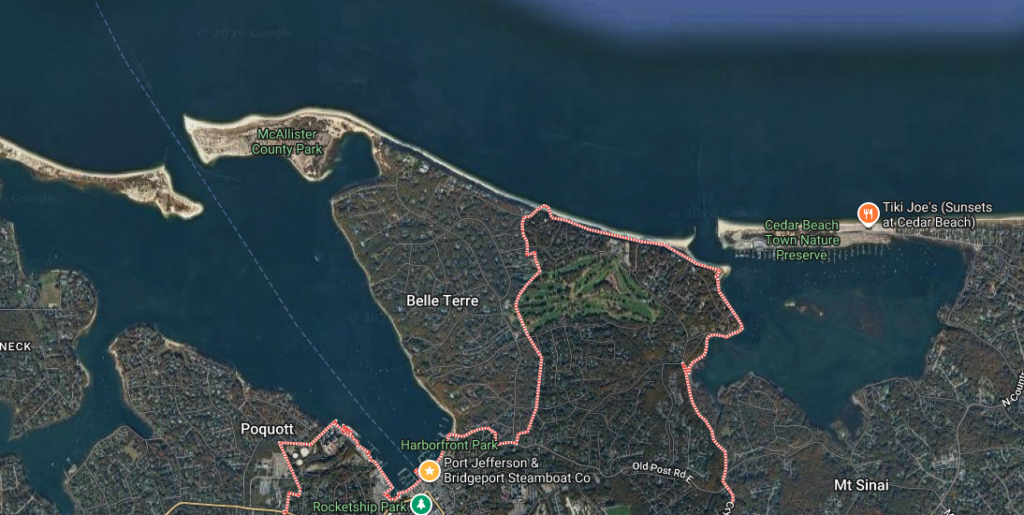
We stored the Star in the back driveway at my parents’ house between seasons (I lived there too, being a minor and all). I’d try to fix the exposed iron on the leaded keel – the iron keel had a coat of lead to keep it from rusting. I used polyester resin, which didn’t hold well, and then switched to epoxy, which did.
My friend Erwin, who I am still friends with, would help with that. I don’t know if I ever took Erwin sailing on any sailboat until Caro Babbo in 2014. I’m not a good friend, I’m afraid.
Arthur Knapp, the author of Race Your Boat Right, was a member of the Larchmont Yacht Club, which spec’d out the Star design, had it built, and held the license to the plans. Knapp tells the story of one member who allowed the keel to rust away, making the boat a killer downwind, but requiring the crew to get out and stand on the keel to bring the boat back to vertical when it took a knock down. He found this very funny, and I found it very puzzling. Knapp had a seat on the New York Stock Exchange (NYSE).††
When I was nineteen, I allowed, by not visiting the boat for a few weeks at a time, the line to the mooring ball to once again wear through. This time the boat caught in one of the channels in the marsh, filled up with water, and the bottom fell out. People had come along and stripped her of anything useful, plus the mast and boom. I was, and still am, very embarrassed about this. I had plans to go back and set her on fire; instead, I cut off her bow, which I still have, and left her to rot. I have no idea what happened to her keel. It could still be buried in the mud these fifty years later.
I continued to sail my Sunfish, which had no flotation. One time, my friend Keith and I, whom I met freshman year at SUNY Stony Brook when he and I had the same schedule, went out in the Sunfish (technically a Funfish) when the sea came up. We’re talking two-foot waves. The boat started to fill, and there was no way to empty it.
We discussed spending the night in the water when a powerboat with two couples came by and rescued us. I have no recollection of how old they were. In my mind’s eye, fifties. But who knows.
As I recount this, I guess the women must have thought we were good-looking. They said one of us, Keith, I think, looked like John Tesch, who was a newscaster on WABC-TV.
They took us into Port Jefferson dock, where we’d parked the car. We bailed the boat and met our girlfriends, whom we were each destined to marry. (Keith is still married to Elizabeth.)
I continued to sail racing dinghies, but never raced them after we left for San Diego, for what was a two-year postdoc.
There were two Lasers I had from a friend with whom I raced a Lightning; He was interested in a retail franchise. Robyn and I would each sail one out to the spit in Port Jefferson Harbor and camp under the large No Camping sign. Robyn was a good sailor. We’d go camping with the two of them stacked on a small flat-bed trailer. We lived in Park Slope, Brooklyn, in those days and stored my 1973 Celica, the boats and trailer in my parents’ back driveway, where years later I would store the T-Bird.
When we brought the assemblage (two lasers with all rigging lashed to the trailer pulled by the Celica with a trailer hitch made from a lentile), two of the neighborhood kids came by to look at the stack.
I remember the two boys as being very Brooklyn and speaking with a serious Brooklyn accent, something people on our block didn’t have – New York is defined by blocks, they are your enclave within your neighborhood. They looked at the trailer, and one of them asked what it was. I said it’s a boat. After a few moments, he replied, it’s not a boat. It has wheels.
We drove to Connecticut, camped, and sailed. Robyn sailed into the marshes at one point, despite me saying that she’d get caught in there. She went anywhere and did, but to my pride and amazement, she tacked her way back out. She really could sail.
When Robyn got her postdoc at UCSD, I proposed we buy a sailboat and live aboard. So, when we went out there to look for a place to live, we saw San Diego harbor, which was an open harbor with dozens of boats anchored near the shore. (By 2019, it was very tightly managed with an effort to keep boats that can’t sail out of the harbor.)
Robyn looked at the boats and, as we looked at apartments, said, ‘‘This will be like camping out, won’t it?’’ I didn’t sail again until 2002, 20 years later.
*number 1113, Taaris, built in Canada,
†Ignoring when I was younger
††He also was the author of the phrase ‘‘Winches like wenches come in many sizes and shapes’’
††† Pelle Petterson – it turns out a new friend, Alex, raced Pelle and beat him – so did a bunch of other people in that race, as apparently Pelle came in tenth.
