
Port Townsend, WA 19-Feb-2026 – This is what I have learned about my Taylors Stove. (I still am not sure whether an apostrophe belongs between the r and the s. I think it might.)
In ten years†, I’ve learned what fuel to use, and no matter what fuel I use, the burner will clog up. But it can be recovered.
Here we go:
- The correct fuel is water-white kerosene, called 1-K. Kerosene is called paraffin in other parts of the world. Do not use any kerosene that is not water-white; it will quickly clog the burner. Don’t use Jet Fuel, not only will it clog up the jets, but it runs very hot, nor #1 diesel.
- Use a torch to preheat the stove. You can use alcohol, like the manual suggests. It also suggests trying a torch. Use a propane torch. A BernzOmatic torch is what I use. Every US hardware store has them. Pay attention to the pricing. Oftentimes, it is cheaper to buy the assembled torch than it is to buy the burner or a canister of propane. Be careful to buy propane and not one of the other fuels.
The manual says it takes 90 seconds to heat the burner so that it is ready. In our experience, three minutes is a safe amount of time. 2-1/2 will often work.
Where to heat the burner? At the stem where the handle that controls the flow of gas connects. Heat the entire stem. Getting the entire stem hot is what heats the fuel. The stem is the chamber where the liquid kerosene turns to vapor.
- How do you clean the burner? And how often? This is what took so long. There was a woman online who said she soaked hers in ammonia every month, and that worked. Ammonia is a basic solution* that dissolves grease, among other things. It didn’t work for me.
It did get me thinking. I use oven cleaner to clean my stove and other things that are very greasy and blackened from heat. Traditional oven cleaner is lye. Lye mixed with fat makes soap in a process called saponification.
I clean the burners with lye. Be careful with the stuff.
To clean, I take three tablespoons of lye†† and place it in a one-pint canning jar that is half full of water. Then I add the burner to be cleaned, then I put the top on the jar, tightly. You will feel the jar heat as the lye dissolves. I leave this to work for 24-48 hours.
Then I rinse the burner, allow it to dry, and then use it. There have been times when the burner was so dirty that it needed to be cleaned again. I do not take apart the burner. I did take it apart once and found it made no difference.
I have, several times in the past, thought I had this all figured out. If you’ve read me musing, loving and hating my Taylors stove, you know all of this. But this time, I think, I really do have it all figured out – just in time for this information to be useless.
I don’t think anyone uses Taylors stoves anymore. The world has gone to propane, with all the risks. A boat blew up and sank yesterday in Port Townsend Bay. Two people ended up being air-flighted to Seattle for burn treatment because of a propane explosion.
Now that I know how a kerosene burner works, let me explain it. It is pretty simple. If you already know, you can stop reading.
Kerosene vaporizes at 428º Fahrenheit.
If you burn liquid kerosene in a stove, you get a very black smoke of unburnt gases that sticks to and stains everything. (You can burn kerosene with a wick, which, when trimmed nice and square, burns well, not with a lot of heat, but with good light.)
In a kerosene burner, like a Taylors or, a Primus or Optimus, the kerosene is heated to 428º or higher and ignited when it leaves the jet under pressure. This is what you are doing when you preheat the burner: the kerosene is vaporized when it passes through the preheat chamber.
When you light the escaping kerosene, it burns quickly and very hot. It also continues to heat the burner and the preheat chamber: the fuel continues to burn clean and hot.
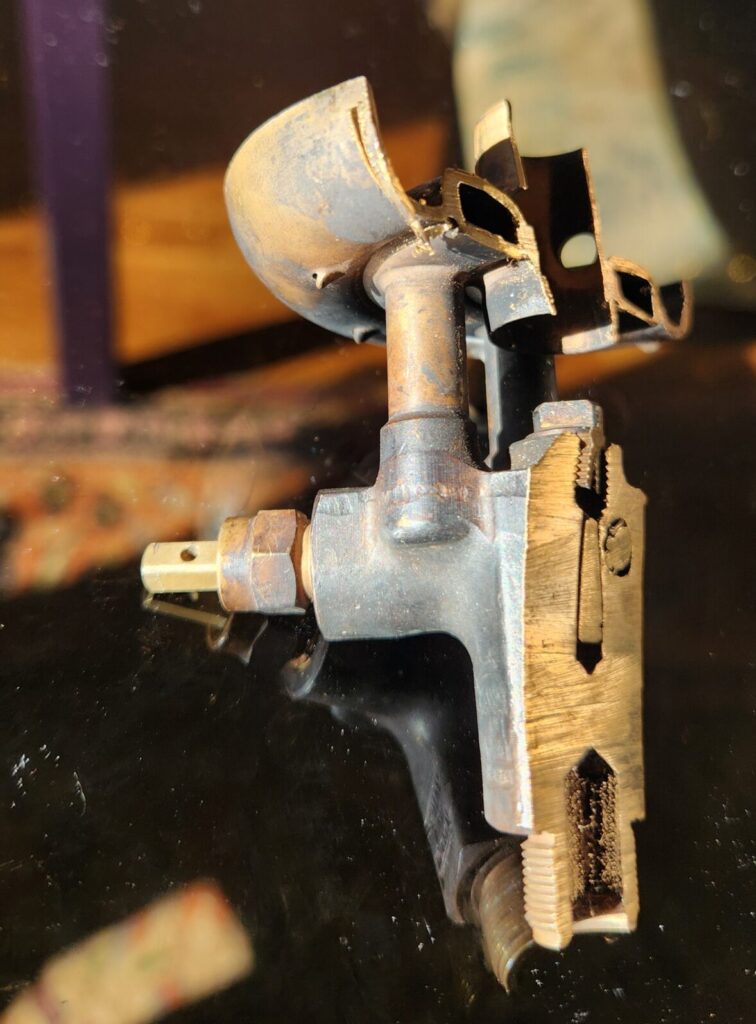
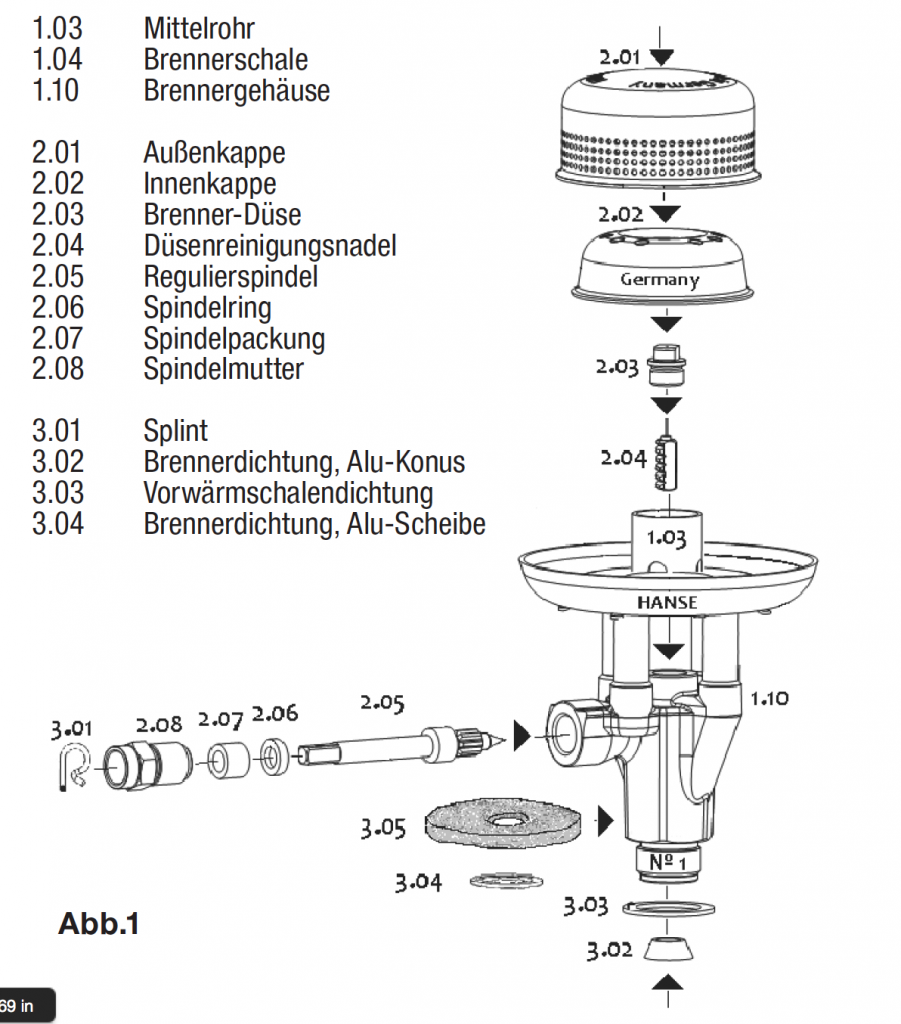
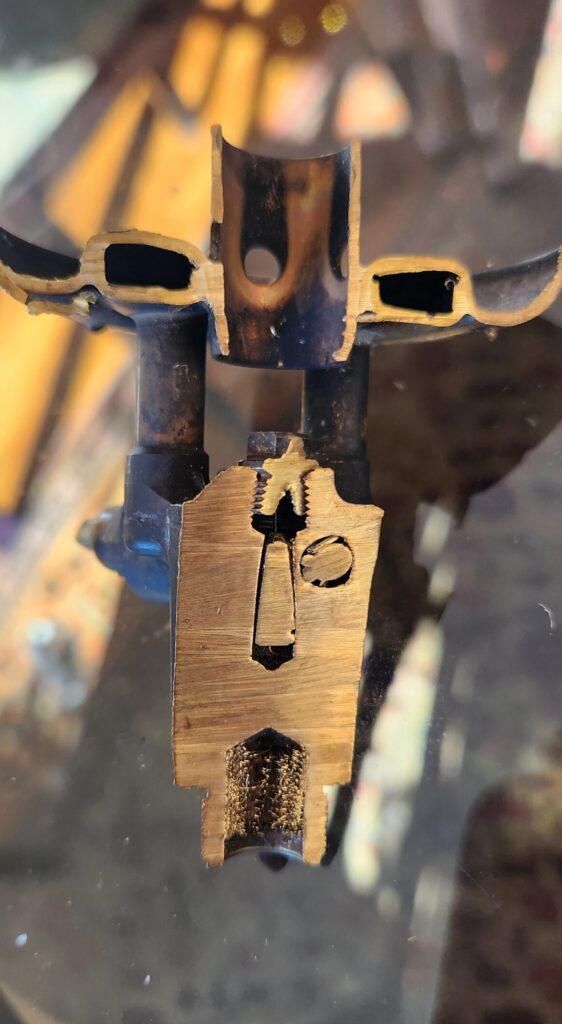
In the accompanying pictures is a burner I had cut in half to expose the preheating chamber and the other parts of the burner.
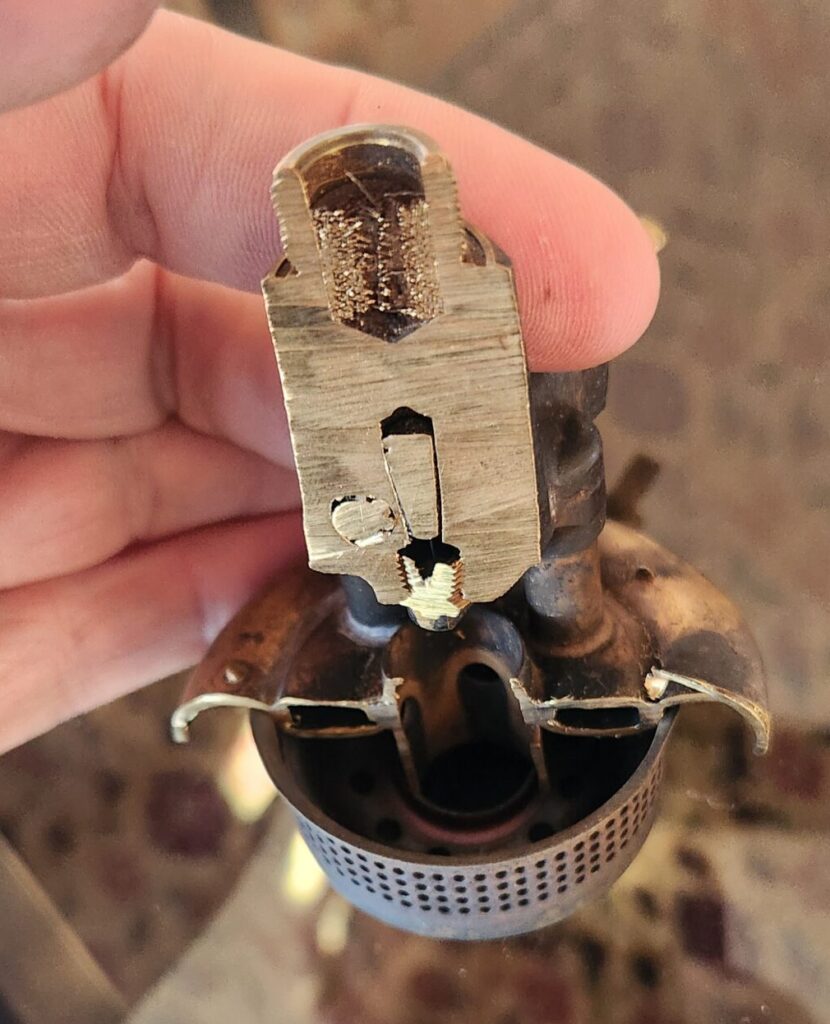
In the bottom of the burner is a tightly wound coil of metal. The purpose of this is to control how quickly the fuel can pass into the preheating chamber – the coil of metal lowers the pressure of the fuel in the burner. In the early models, it was done differently with a metal part that fit. The gap in the part limited the amount of fuel, and the pressure. The instructions said, in a pinch you could use the burner without that part, IF you open the valve only a small amount.
That’s it. That’s pretty much all I know about the burner, and it only took ten years to learn it all.
† There is a post about the stove with a discussion of the parts. It is from 2017, nine years ago almost to the day. https://carobabbo.com/2017/02/18/the-demise-of-the-taylors-stove/ The comments are quite good, though no one ever responded to me.
*versus acidic solution
†† You can buy lye in a hardware store.
