Ovation of the Seas, 50º 57N 159º 22E, 7- May-2026 – We’re traveling at 20 knots in pretty calm water. It has been foggy. The ship has been blowing a fog horn: One long blast every two minutes.
There are 4100 guests and 1500 staff, close to 7000 people on board. Except at meals, it feels like less. At the start of meals, it is very crowded at lunch and breakfast. The other meals aren’t too bad. Most of the passengers have set times they eat at the same table with the same people, so there is some order.
The passengers must be 50% or better Canadian, with a large number of Asians – I don’t know from where. There are Chinese, Malay, and others. I can’t tell unless they speak their own language, and most speak English. There are South Americans and very few Europeans. Or so it seems to me.
The staff is mostly Indonesian, Malay, Filipino and Indian. No Pakistani that I could tell. The staff is very friendly, kind of. They don’t really listen when you respond. I can’t tell if it’s language, or whether they just don’t listen. They often respond before you finish speaking with something like that’s wonderful… even if it is not.
Eating is a big deal… the food is very bland. We shared tables the first two dinners and vowed never to do that again. We were lectured for the entire dinner – nothing political, just generally about the wonders of cruising on the behemoth boats. We stopped doing that.
We have made a few friends: a Canadian couple, and possibly a Colombian couple. We’ve also started recognizing people that we’ve met in the crowd.
The ship is 16 decks, most are cabins (the hotel, as the crew refers to it), with the remaining decks for entertainment and eating, with the bar venues playing both roles. The entertainment is quite good – A reminder that there is a lot of very good talent with no place to work. The solarium is a large space on the bow of the ship, all glass with a good number of pools and hot tubs. The first day, most of the chairs were taken by 8 am. We got there around 6, thanks to Jennifer needing to be up and out very early for coffee – and ostensibly other things.
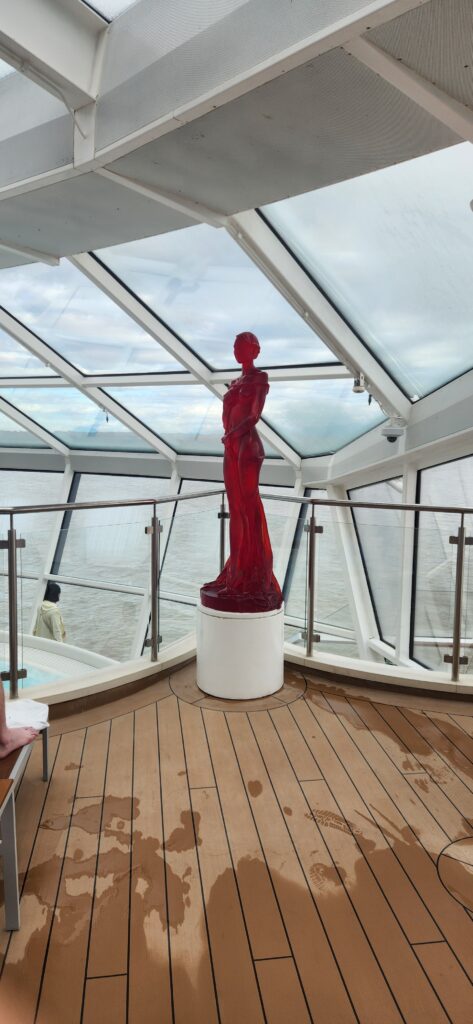
We met a couple there, Canadian (I’ve learned I should put ‘‘of course’’ behind Canadian), who talked to us about cruising and what they do. Most people have been on many cruises; twenty or more is not uncommon. I haven’t figured out whether some of these people have retired to cruise ships. With an inside berth, it is cheaper than a retirement community with decent, varied food and new places all the time.
I could give a litany of the people we’ve met, but it will do just to say they are all very nice and a cross-section of people. Most are older, close to my age, but there is a large standard deviation. They represent the same cross-section in fitness and weight. Very few thin people (Jennifer started as one), but there are a number who are trim and just as many who are seriously obese. It is a cross-section of people, mostly Canadians.
We took a tour called Behind the Seas, a play on behind the scenes, I guess. Plays on words are very popular on this ship. The biggest criticism that everyone has is nickel and diming and the constant, it seems, reaching for more cash. The one that has shown up the most for us is that during the refitting, they halved the size of the gym. It is very crowded when Jennifer and I have gone after the first day. In fact, we haven’t been since, just passing by, seeing the crowd, and kept moving.
The tour was very good. It was led by a very tiny, very attractive Malay named Eli who knew about the ship. The tour takes two hours and visits most of the behind-the-scenes places that we all depend on.
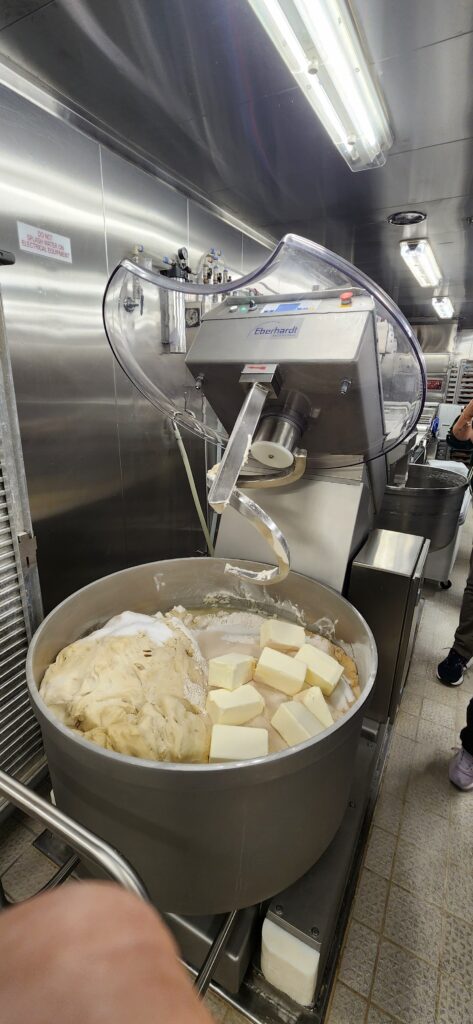
The kitchen is a commercial/industrial kitchen turning out huge quantities of food. There are, in fact, four of them. The baking is all done fresh, as are many other things. A lot, I suspect, is canned or, of course, cheeses, cold cuts, etc are brought on board as is. This includes yogurt, etc. The salad dressings taste like Sysco, second tier. The food is uniformly bland, which is a pity, but it is the least common denominator.
The bridge is quiet and very cleanly laid out. Jennifer was disappointed because the officers running the bridge didn’t engage her like the people running the many large fishing boats she’s been on. This is also a corporate boat. There are no decisions to be made about which weather model to listen to. When Jennifer asked, she was told it is the corporate model, and he had no idea which one it was.
Saturday, day nine, we’ll go to a Q&A session with the captain where I’ll be able to ask about why we’re running on the rhum line rather than taking the great circle, and why the exhaust from the stacks is seriously yellow, rather than invisible as it was when we were in Japan.
We visited the laundry facility, and I learned about commercial laundries, which have 12 stages: big vertical machines where the laundry passes from machine to machine for the various washing and rinsing. The big ironing machines for the sheets is on another floor, so we didn’t go there, but he explained the different temperatures the various pieces of material come out of the dryer, so they can go to the ironing machine or not. (Lower temperatures have more water.)
We visited the engine control room. The drive is a generator motor setup that our friend Ray Penson told us about. This boat has four generators, which spin up depending on how much power is needed. There are two small generators and two large. These supply electricity for the entire boat – as opposed to what I was told when I asked some crew member I met (more on asking crew members’ advice later).
The power is through three pods that can rotate 360-degrees; there is no rudder. So they rotate 180 for reverse and 90 to act as stern thrusters. Very cool. There are four bow thrusters, btw.
In the engine control area, there were also diagrams of the water makers. They use distillation and RO (reverse osmosis). They also ‘‘bunker’’ water they pick up at the docks. The bunkered water is used for swimming pools, according to Eli.
Waste water, both gray and black, is processed and pumped overboard. Kitchen vegetable matter is dried and burned, as is most combustible, non-plastic trash.
It was a cool tour. I recommend it.
The next morning, I went to a Q&A with the Hotel and Restaurant senior management. It was interesting, but what was most interesting was how everyone toes the corporate line. When someone asked why the gym was cut in half, the answer was that it was a corporate decision, ‘‘we weren’t told why.’’ The answer is clearly revenue increase as was everything done in the refit. The other half of the gym was turned into suites. There was a bar with a two-story ceiling that was changed to a one-story ceiling, and another bar was put on top. There are forty new rooms in the hotel: they had to come from somewhere.
Royal Caribbean is an American Company and in many ways acts like one.
Next, a discussion of the people who work on board with one of the senior staff.
[End of Part 2]
